Anunnaki
Article
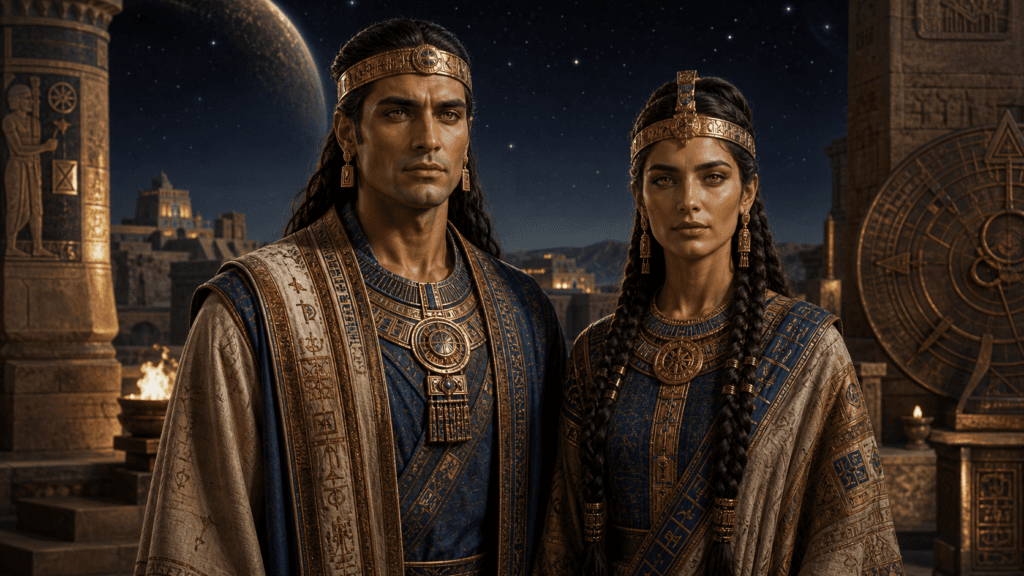
An artistic interpretation of reported male and female Anunnaki. The image combines characteristics associated with ancient Mesopotamian divine imagery and later extraterrestrial interpretations.
Also Known As: Anunna, Anunnaku, Anunnaki
Classification: Ancient Mesopotamian Deity Group and Reported Humanoid Extraterrestrial Intelligence
Ancient Cultural Origin: Sumerian, Akkadian, Babylonian, and Assyrian traditions
Reported Extraterrestrial Origin: Nibiru or another celestial location, according to modern interpretations
Reported Form: Humanlike or larger humanoid
Status: Documented in ancient Mesopotamian religion and reinterpreted as extraterrestrial beings in modern alternative literature
Overview
The Anunnaki occupy two connected but distinct places in history. In ancient Mesopotamian texts, they are a group of powerful deities associated with divine authority, the ordering of the world, the determination of destinies, and, in some traditions, the heavens or underworld.
In modern extraterrestrial interpretations, the Anunnaki are described as an advanced humanoid civilization that came to Earth in the distant past. These accounts frequently connect them with human origins, genetic intervention, ancient technology, the development of civilization, and a celestial body called Nibiru.
The ancient religious tradition is preserved in cuneiform texts and archaeological material. The extraterrestrial interpretation developed much later through alternative readings of that material, particularly during the twentieth century.
Because both traditions remain important to the modern understanding of the Anunnaki, Mystera Headquarters documents them separately while recognizing the relationship between them.
Name and Terminology
The Sumerian term Anunna and the Akkadian forms Anunnaki or Anunnaku refer to a group of deities in ancient Mesopotamian tradition.
The name is commonly interpreted as meaning something similar to princely offspring or offspring of An. An, also called Anu in Akkadian tradition, was the Mesopotamian god associated with the heavens and divine authority.
Ancient texts do not always use the name for precisely the same group. In some sources, the Anunna are the highest-ranking gods. In others, the name may refer to the divine assembly of a particular city or to deities connected with the underworld.
The modern term Anunnaki is now widely used for both the ancient deity group and the reported extraterrestrial civilization.
The Anunnaki in Ancient Mesopotamia
The Anunnaki appear in the religious traditions of ancient Sumer, Akkad, Babylonia, and Assyria. They were not always presented as one species or a fixed group with an unchanging list of members. Instead, the name could identify an assembly of important gods whose membership and responsibilities varied by place and period.
Ancient texts associate the Anunnaki with divine decisions, kingship, judgment, cosmic order, and the determination of human destiny. Some traditions place members of the group in the heavens, while others connect them with the underworld.
Prominent deities associated with the larger Anunnaki tradition include:
- An or Anu: God of the heavens and a source of divine authority
- Enlil: God associated with wind, atmosphere, authority, and kingship
- Enki or Ea: God associated with fresh water, wisdom, creation, and craft
- Ninhursag: Mother and fertility goddess associated with birth and the earth
- Inanna or Ishtar: Goddess associated with love, sexuality, power, and warfare
- Ereshkigal: Ruler of the Mesopotamian underworld
- Nanna or Sin: Moon god
- Utu or Shamash: Sun god associated with justice
The identity and number of Anunnaki vary among surviving texts. The term represents a divine grouping rather than a single character.
Development of the Extraterrestrial Interpretation
The modern extraterrestrial interpretation of the Anunnaki was strongly influenced by author Zecharia Sitchin. His 1976 book, The 12th Planet, presented the Anunnaki as technologically advanced beings connected with a planet called Nibiru.
Sitchin interpreted ancient Mesopotamian stories as records of extraterrestrial activity. In his account, the Anunnaki came to Earth, established settlements, gathered resources, and participated in the creation or development of humanity.
His work became highly influential within ancient astronaut research, alternative history, UFO studies, and modern spiritual communities. Later authors, speakers, experiencers, and researchers expanded the tradition with additional accounts of Anunnaki factions, bloodlines, technology, and involvement with human civilization.
Standard academic translations interpret the ancient Anunnaki as Mesopotamian deities. The description of them as visitors from another planet belongs to the later extraterrestrial interpretation of those traditions.
Reported Origin and Nibiru
In modern extraterrestrial accounts, the Anunnaki are frequently associated with Nibiru. Sitchin described Nibiru as a distant member of the solar system following a long, elliptical orbit.
The word Nibiru does appear in ancient Mesopotamian astronomical and religious texts, but its meaning depends on the text. It can refer to a crossing point or a particular celestial object, and it is sometimes associated with the god Marduk. Ancient references do not provide one consistent description of Nibiru as the inhabited home planet presented in modern Anunnaki literature.
Other modern accounts place the Anunnaki in a distant star system, another dimension, or an unidentified region beyond the known planets. Some traditions suggest that Nibiru may be a spacecraft, artificial world, or name for a larger civilization rather than an ordinary planet.
Astronomers continue to investigate whether an undiscovered planet may exist far beyond Neptune. The hypothetical object commonly called Planet Nine has not been observed and is not identified by astronomy as the Nibiru described in modern Anunnaki traditions.
Reported Habitat on Earth
Modern accounts often place important Anunnaki settlements in ancient Mesopotamia, particularly in the region of Sumer. Cities such as Eridu, Nippur, Uruk, and Sippar are associated with major Mesopotamian deities and are sometimes interpreted as former Anunnaki centers.
Alternative traditions describe temples as communication centers, administrative complexes, observatories, or locations where humans interacted with the Anunnaki. Some accounts also propose settlements in Africa and other regions connected with ancient mining, astronomy, or monumental construction.
Within ancient Mesopotamian religion, temples were sacred residences where a deity’s presence was maintained through statues, offerings, rituals, and priestly service. The interpretation of these sites as extraterrestrial installations belongs to the later ancient astronaut tradition.
Reported Appearance
Ancient Mesopotamian deities were generally represented in human form. Divine figures can often be distinguished in art by horned crowns, elaborate garments, ceremonial objects, or symbols associated with their powers.
The Anunnaki were not consistently shown with wings. Winged figures in Mesopotamian art may represent protective beings, spirits, sages, or other supernatural figures, and should not automatically be identified as Anunnaki.
Modern extraterrestrial accounts often describe the Anunnaki as tall, humanlike beings. Frequently reported characteristics include:
- Greater height than the average human
- Strong or proportionate bodies
- Humanlike facial features
- Large or intense eyes
- Dark, reddish, bronze, golden, pale, or human-range skin tones
- Dark, light, red, or golden hair
- Ceremonial robes, armor, or fitted garments
- A commanding or radiant presence
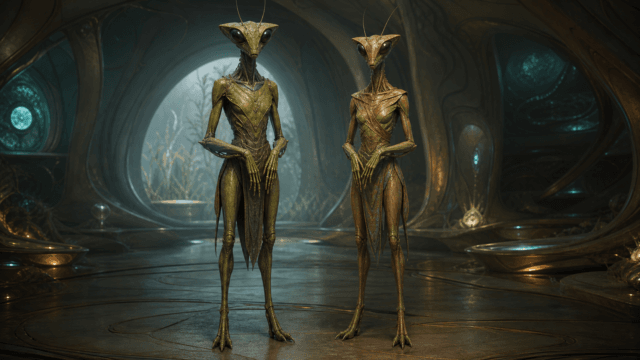
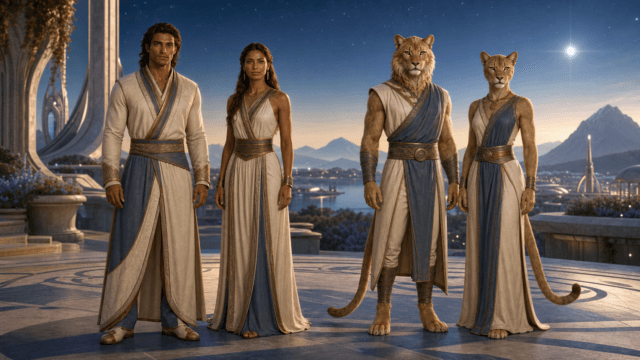
Reported males are often portrayed as tall, broad-shouldered, and physically powerful, sometimes with beards or long hair. Reported females are commonly described as tall and regal, with proportionate humanlike features and long hair. Both may be shown wearing elaborate clothing, jewelry, headdresses, or symbols of rank.
These descriptions combine modern contact traditions with artistic interpretations inspired by Mesopotamian imagery. Human ideas of male, female, sex, and gender may not completely represent the beings described in extraterrestrial accounts.
Reported Biology
Modern accounts generally portray the Anunnaki as biological humanoids with exceptionally long lifespans. Their longevity is attributed to natural biology, advanced medicine, genetic knowledge, technological intervention, or differences between their world and Earth.
Some traditions describe them as physically compatible with humans or capable of combining their genetic material with early human populations. This idea forms an important part of modern claims concerning the Anunnaki and human origins.
Ancient Mesopotamian texts present the Anunnaki as divine beings rather than documenting them through biological categories. Descriptions of their genetics, lifespan, and physical requirements belong primarily to modern extraterrestrial interpretations.
Reported Society and Behavior
Both ancient and modern traditions portray the Anunnaki as hierarchical. Authority is often connected with ancestry, rank, responsibility, and membership in a divine or governing council.
In ancient stories, Mesopotamian deities display a wide range of personalities and intentions. They form alliances, disagree, compete for authority, protect cities, grant knowledge, impose consequences, and make decisions affecting humanity.
Modern extraterrestrial accounts often describe separate Anunnaki factions. Enki is commonly portrayed as sympathetic toward humanity, while Enlil is often presented as stricter and more concerned with authority or control. These simplified roles vary by source and do not capture every ancient portrayal of either deity.
Some modern traditions describe the Anunnaki as rulers or genetic creators. Others view them as teachers, colonists, scientists, ancestors, or a civilization containing individuals with different motives.
Humanity and Genetic Intervention
One of the best-known modern claims is that the Anunnaki participated in the creation or genetic development of humanity.
Sitchin’s interpretation describes the Anunnaki combining their own genetic material with an existing Earth hominid to produce humans capable of performing labor. Later traditions expanded this idea by connecting Anunnaki genetics with human intelligence, physical development, royal bloodlines, and differences among ancient populations.
Ancient Mesopotamian creation stories do describe gods creating human beings. In texts such as Atrahasis, humans are made from clay combined with material from a slain deity so they can perform labor previously carried out by lesser gods.
The ancient account is expressed through religious and mythological language. The description of this event as laboratory-based genetic engineering is a modern interpretation.
Gold Mining and Resource Claims
Modern Anunnaki traditions frequently claim that the beings came to Earth in search of gold. In some versions, gold was needed to repair or protect the atmosphere of their home world. Humans were then created or modified to assist with mining and labor.
This claim is closely associated with Sitchin’s writings and later ancient astronaut literature. It is not directly stated in standard academic translations of Mesopotamian creation texts.
Gold was important in ancient Mesopotamia and surrounding regions as a valuable material connected with wealth, temples, royalty, and divine imagery. The specific story of large-scale Anunnaki gold mining belongs to the modern extraterrestrial tradition.
Reported Communication
Ancient Mesopotamian traditions describe communication with deities through dreams, omens, divination, prayer, ritual, prophecy, and temple service. Priests and rulers sought divine guidance before making important decisions.
Modern accounts attribute telepathy, direct mental transmission, advanced language systems, symbolic communication, and technological messaging to the Anunnaki.
Some experiencers report contact through meditation, dreams, channeling, visions, or a strong sense of ancestral connection. Interpretations of these experiences vary among individuals and traditions.
Reported Abilities and Technology
In ancient texts, the Anunnaki and related deities possess divine powers over nature, kingship, fertility, wisdom, judgment, warfare, and human destiny.
Modern extraterrestrial interpretations describe these powers as the products of advanced technology or developed consciousness. Reported Anunnaki capabilities include:
- Interplanetary or interstellar travel
- Genetic engineering
- Advanced medicine and life extension
- Energy generation and manipulation
- Climate or environmental control
- Large-scale construction
- Astronomy and celestial navigation
- Telepathy and consciousness-based communication
- Advanced weapons and protective systems
Some modern researchers interpret ancient stories of divine vehicles, radiant beings, powerful weapons, and heavenly journeys as descriptions of technological events. Others understand the same passages through religious, symbolic, literary, or cultural frameworks.
The Flood Tradition
Flood narratives are important in both ancient Mesopotamian literature and modern Anunnaki interpretations.
Mesopotamian texts including Atrahasis and the Epic of Gilgamesh describe a great flood sent by the gods. A chosen survivor is warned, constructs a vessel, preserves life, and survives the disaster.
Modern Anunnaki accounts sometimes interpret the flood as a natural catastrophe known in advance by extraterrestrial visitors. Other versions describe it as an intentional attempt by one Anunnaki faction to reduce or eliminate the human population, while another faction intervened to preserve humanity.
The Mesopotamian flood tradition is ancient and well documented. Its interpretation as an extraterrestrial event developed much later.
Reported Presence on Earth
Modern traditions place the Anunnaki on Earth during remote periods of human history. They are associated with Mesopotamia, early cities, kingship, agriculture, astronomy, writing, monumental architecture, and the development of organized civilization.
Some accounts describe their eventual departure from Earth. Others propose that certain Anunnaki remained, continued to observe humanity, or maintained contact through selected individuals and groups.
Reported modern contact includes dreams, meditation, channeling, ancestral memories, spiritual experiences, and encounters interpreted as communication with Anunnaki beings.
Evidence and Interpretation
The Anunnaki are firmly documented as a group of deities within ancient Mesopotamian religion. Their names, roles, and stories appear in surviving cuneiform texts studied by historians, archaeologists, linguists, and specialists in the ancient Near East.
The interpretation of the Anunnaki as an extraterrestrial civilization is based primarily on modern readings of ancient material, alternative history, spiritual communication, and contact traditions.
No publicly verified biological evidence has established the Anunnaki as a scientifically recognized extraterrestrial species. Astronomy has also not identified an inhabited planet corresponding to the Nibiru described in modern Anunnaki literature.
This does not determine how every ancient text or personal experience should be understood. Readers may interpret the Anunnaki as deities, extraterrestrial visitors, spiritual intelligences, cultural symbols, historical memories, or through a combination of these possibilities.
Mystera Headquarters Classification
Mystera Headquarters classifies the Anunnaki as an ancient Mesopotamian deity group with a later reported extraterrestrial interpretation.
They are included in this encyclopedia because modern contact traditions and ancient astronaut literature widely describe them as a humanoid extraterrestrial civilization connected with humanity’s early development.
The ancient Mesopotamian tradition and the modern extraterrestrial interpretation are identified separately so that readers can understand the origins and development of both.
Editorial Notice
This entry documents ancient traditions, reported accounts, and modern interpretations concerning the Anunnaki. Details may vary by source and are presented for informational and research purposes.
Sources and Further Reading
Anunna, Anunnaku, Anunnaki: A Group of Gods, Ancient Mesopotamian Gods and Goddesses, ORACC
Gods, Demons and Symbols of Ancient Mesopotamia, University of Texas Press
Gods, Demons and Symbols of Ancient Mesopotamia, WorldCat
The Electronic Text Corpus of Sumerian Literature, University of Oxford
The 12th Planet by Zecharia Sitchin, Google Books
Hypothetical Planet X, NASA Science
NASA’s WISE Survey Finds Thousands of New Stars, but No Planet X
Published by Mystera Headquarters
© 2026 Mystera Headquarters. All rights reserved.