Lyrans
Article
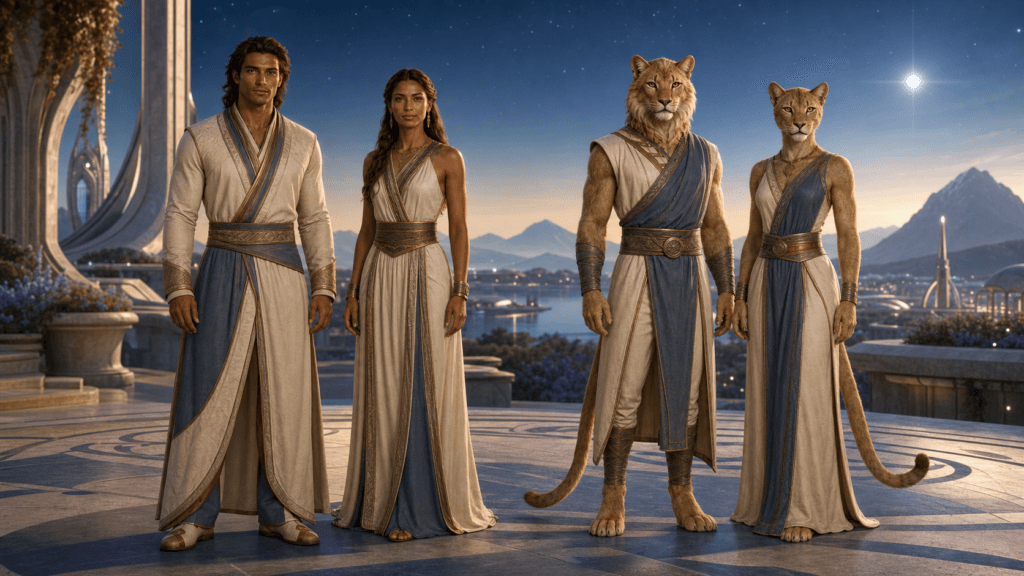
Artistic interpretation of two alleged Lyrans representing the humanlike and feline humanoid forms described in modern channeled and contactee literature. Their appearance and physical differences are speculative and are not supported by verified biological evidence.
Encyclopedia Entry: 011Also known as: Lyrians, beings of Lyra, Lyran humanoids, Lyran felinesClassification: Alleged family of extraterrestrial or interdimensional intelligencesReported origin: The region of the constellation LyraEntity type: Humanoid and feline humanoid, depending on the sourceStatus: UnverifiedPrimary tradition: Channeled teachings, contactee literature, and starseed spirituality
Overview
Lyrans are an alleged family of extraterrestrial civilizations associated with the constellation Lyra. Modern accounts frequently portray them as ancestors of numerous humanlike civilizations throughout the galaxy.
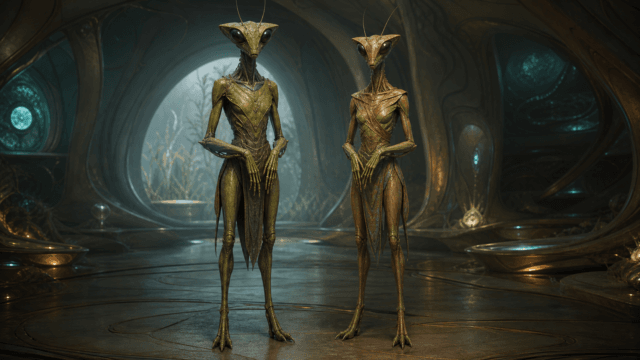
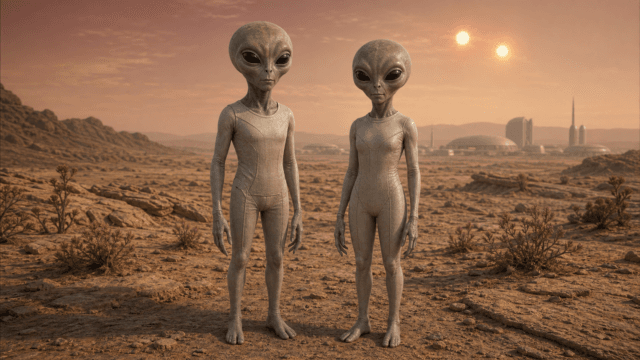
Rather than describing one consistent species, Lyran literature presents several different physical forms. These include humanlike beings, feline humanoids, giants, birdlike beings, and other reported types.
The modern Lyran tradition developed primarily through channeled material and New Age contact literature. One influential source is The Prism of Lyra by Lyssa Royal and Keith Priest, originally published around the beginning of the 1990s and later released in revised editions.
No scientific evidence confirms that intelligent civilizations inhabit the Lyra constellation or that humans originated from extraterrestrial Lyran ancestors.
Name and Terminology
The name Lyran is derived from Lyra, a constellation in the northern sky. Lyrian is an alternative spelling found in online communities and spiritual literature.
Lyran may refer to:
Any alleged being originating in the Lyra region
A proposed ancient family of humanoid civilizations
Humanlike beings specifically associated with Lyra
Feline humanoids said to come from Lyran worlds
Souls believed to have lived previously within a Lyran civilization
A spiritual identity adopted within starseed communities
Because the term is used so broadly, two sources may describe very different beings while calling both of them Lyrans.
Mystera Headquarters treats Lyrans as a family or tradition rather than one biologically uniform species.
Development of the Modern Tradition
The idea of humanlike extraterrestrials predates the modern Lyran tradition. Contactees of the 1950s frequently described attractive humanlike visitors from nearby planets, while later writers relocated similar civilizations to distant star systems.
Detailed Lyran narratives became especially influential through the channeled work of Lyssa Royal. Royal began channeling professionally during the 1980s and worked with Keith Priest on books concerning alleged extraterrestrial history and human spiritual development.
The Prism of Lyra: An Exploration of Human Galactic Heritage presented Lyra as an important point in a symbolic or cosmic history of humanoid consciousness. The book connected alleged Lyran civilizations with Vega, the Pleiades, Sirius, Orion, Zeta Reticuli, and Earth.
Later writers and online communities expanded the narrative. Some additions introduced elaborate wars, royal houses, feline civilizations, planetary names, genetic lineages, and migration routes that do not appear consistently in earlier sources.
The Lyra Constellation
Lyra is a real constellation located in the northern celestial hemisphere. Its brightest star is Vega, one of the brightest stars visible from Earth.
The constellation also contains several known stars, planetary systems, and deep-sky objects. However, a constellation is a pattern seen from Earth’s perspective. Its stars are not necessarily close together in physical space.
Referring to a civilization as originating from Lyra therefore does not provide a precise astronomical location. A scientifically useful claim would need to identify a particular star, planet, distance, and method of detection.
No confirmed inhabited world has been found in the Lyra constellation.
Reported Appearance
Descriptions of Lyrans vary considerably. Frequently reported forms include:
Humanlike beings with proportions similar to those of humans
Tall humanoids with athletic or powerful builds
Feline humanoids with fur, catlike faces, and mobile ears
Red-haired humanlike beings
Dark-haired or fair-haired humanlike beings
Dark-skinned humanoids
Giant humanoid forms
Birdlike or avian-related beings
Some modern images portray all Lyrans as lionlike or catlike. This is only one branch of the wider tradition. Earlier and broader sources describe several alleged Lyran body types.
No verified information establishes how Lyrans reproduce or whether human concepts of male and female apply to every reported subtype. Artistic depictions should therefore avoid exaggerated or sexualized anatomy.
Humanlike Lyrans
Humanlike Lyrans are often described as physically similar to people from Earth. Accounts may give them a range of skin tones, hair colors, eye colors, heights, and facial structures.
They are sometimes portrayed as among the earliest humanoid populations in the local region of the galaxy. Later civilizations associated with the Pleiades, Vega, Sirius, and Earth are claimed to descend from Lyran ancestors.
These proposed genealogies originate in channeled and contactee literature. They are not supported by human genetics, evolutionary biology, archaeology, or astronomy.
Human genetic evidence shows that our species developed on Earth through an evolutionary history shared with other terrestrial life.
Feline Lyrans
Feline Lyrans are one of the most recognizable forms in recent spiritual and extraterrestrial artwork. They are typically portrayed as upright humanoids with characteristics resembling lions, cats, leopards, or other felines.
Reported features include:
Feline faces or muzzles
Fur covering part or all of the body
Mobile catlike ears
Large expressive eyes
Humanoid arms, hands, legs, and posture
Strong or athletic builds
Tails in some accounts
Gold, white, tan, brown, black, or spotted fur
Modern sources often associate feline Lyrans with courage, protection, independence, creativity, and leadership. These qualities closely resemble human symbolism concerning lions and cats.
No biological evidence confirms the existence of intelligent feline humanoids in Lyra or elsewhere.
Claimed Galactic Ancestry
A central claim in the Lyran tradition is that Lyra was an early center of humanoid civilization. Various accounts describe Lyrans migrating to other regions after conflict or planetary destruction.
Claimed destinations include:
Vega
The Pleiades
Sirius
Orion
Arcturus
Alpha Centauri
Earth
Some narratives call these migrations the Lyran Wars or the Lyran Diaspora. The conflicts are sometimes described as involving reptilian or Draconian civilizations.
Details differ between authors. Dates, participants, locations, and outcomes are not consistent, and no astronomical or archaeological evidence confirms that these events occurred.
Reported Society and Culture
Lyran civilizations are generally portrayed as diverse rather than culturally uniform. Reported characteristics include:
Strong individual identity
Creativity and artistic expression
Exploration and colonization
Spiritual development
Respect for personal freedom
Advanced knowledge of genetics
Close relationships with nature
Warrior and protector traditions
Complex family or royal lineages
Tension between individual freedom and social authority
Humanlike Lyrans are sometimes associated with settlement and technological development. Feline Lyrans are frequently portrayed as protectors, teachers, or guardians.
These characteristics originate from channeled narratives and later spiritual interpretations.
Reported Abilities and Technology
Accounts attribute several abilities and technologies to Lyrans, including:
Telepathic communication
Heightened intuition
Advanced healing
Genetic engineering
Interstellar spacecraft
Consciousness-based technology
Energy manipulation
Remote viewing
Interdimensional travel
Long life spans
Some sources describe early Lyrans as technologically advanced but less spiritually developed than their descendants. Others portray them as ancient beings with mastery of both technology and consciousness.
No device, communication, or biological ability attributed to Lyrans has been independently verified.
Relationship to Pleiadians
Many modern narratives describe Pleiadians as descendants of Lyran refugees or colonists. Under this interpretation, humanlike beings migrated from Lyra to star systems associated with the Pleiades and established new civilizations.
This proposed relationship helps explain why descriptions of Lyrans and Pleiadians often overlap. Both may be portrayed as tall, attractive, humanlike beings with advanced spiritual teachings.
Mystera Headquarters maintains separate entries because Pleiadian traditions developed through their own contactees, books, teachings, and claimed locations.
Relationship to Feline Humanoids
Not every alleged feline humanoid is identified as Lyran. Some sources place feline civilizations near Sirius, Orion, or unidentified star systems.
Likewise, not every Lyran is described as feline.
Mystera Headquarters uses Lyran Felines for feline beings specifically associated with the Lyran tradition. Feline Humanoids may later be cataloged as a broader category if sufficient distinct traditions are documented.
Lyran Starseeds
Within starseed spirituality, a person may identify as a Lyran starseed. This usually means the individual believes their soul previously lived in Lyra or maintains a spiritual connection with Lyran consciousness.
Traits attributed to Lyran starseeds may include:
Independence
Creativity
Courage
Curiosity
Strong personal will
Discomfort with authority
Interest in ancient civilizations
A desire for freedom and exploration
A feeling that Earth is not their original home
These descriptions are spiritual identity frameworks rather than scientifically validated methods of determining a person’s origin.
No genetic or medical test can establish that someone is a Lyran starseed.
Connections to Ancient Cultures
Some writers connect Lyrans with ancient Egypt, Mesopotamia, India, Atlantis, Lemuria, or other civilizations. Feline Lyrans are sometimes associated with lion-headed or cat-related deities.
Visual resemblance does not establish extraterrestrial contact. Cats and lions held religious importance in several cultures because of their observable strength, behavior, hunting ability, and relationship with humans.
Ancient images must be interpreted within their historical and cultural contexts. Claims that a deity represents a Lyran visitor require evidence beyond a feline appearance.
Racial and Ideological Concerns
Certain versions of Lyran lore organize humanlike beings according to skin color, hair color, or physical appearance. Some accounts have connected fair skin or particular features with higher spiritual development.
Such claims are not supported by genetics, anthropology, or biology. Human skin color is an adaptation influenced largely by ancestry, geography, and ultraviolet radiation. It does not determine intelligence, character, spiritual value, or evolutionary status.
Mystera Headquarters does not endorse racial hierarchies. Descriptions of different humanlike Lyran appearances are recorded as elements of the literature without treating any appearance as superior.
Evidence and Interpretation
No publicly verified body, genetic sample, spacecraft, astronomical signal, artifact, or authenticated communication confirms the existence of Lyrans.
Available material consists primarily of:
Channeled teachings
Contactee testimony
Spiritual experiences
Past-life regression accounts
Starseed beliefs
Books and online articles
Artistic interpretations
Comparisons with ancient mythology
Supporters may understand these accounts as memories, spiritual knowledge, or contact with independent intelligences. Researchers may examine them as modern mythology, New Age religion, symbolic storytelling, altered-state experience, or identity formation.
The cultural and spiritual importance of a belief does not establish its scientific accuracy.
Mystera Headquarters Classification
Mystera Headquarters classifies Lyrans as an unverified alleged family of humanoid and animal-featured intelligences originating primarily in modern channeled and contactee literature.
Humanlike and feline Lyrans are recorded as reported subtypes within the broader Lyran tradition.
Editorial Notice
This encyclopedia entry documents claims, beliefs, reported experiences, and cultural traditions concerning alleged non-human intelligences. Inclusion does not constitute proof that the beings or events described are real.
Descriptions of Lyran appearance, ancestry, origin, society, abilities, technology, and relationships with humanity are attributed to their respective sources and should not be interpreted as established scientific facts.
Sources and Further Reading
Lyssa Royal and Keith Priest, The Prism of Lyra, Google Books
Lyssa Royal, official paperback book catalog
Lyssa Royal, “ETs and Ancient Civilizations”
Encyclopedia.com, Royal Priest Research
JSTOR, Alien Worlds: Social and Religious Dimensions of Extraterrestrial Contact
Oxford Research Encyclopedia of Literature, “UFOs, UAPs, Aliens, and Extraterrestrials”
Cambridge University Press, “On the Plurality of Inhabited Worlds”
Benjamin E. Zeller, “At the Nexus of Science and Religion: UFO Religions”
Encyclopedia of Extraterrestrial and Non-Human Intelligences, Entry 011
Published by Mystera Headquarters
© 2026 Mystera Headquarters. All rights reserved.