Insectoid Humanoids

Article
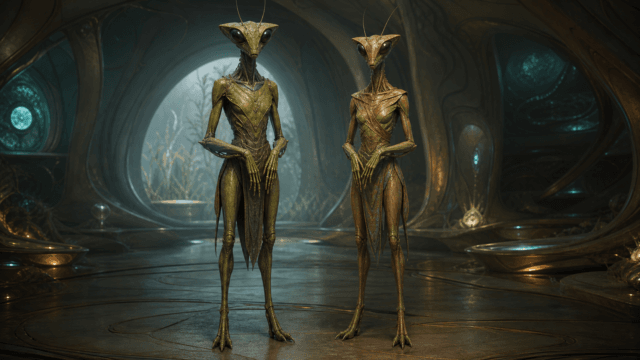
Artistic interpretation of two alleged insectoid humanoids based on recurring descriptions in encounter reports, altered-state experiences, and modern extraterrestrial literature. Their appearance and physical differences are speculative and are not supported by verified biological evidence.
Encyclopedia Entry: 010Also known as: Insectoids, insect beings, arthropod humanoids, buglike entitiesClassification: Broad category of alleged extraterrestrial, interdimensional, or visionary intelligencesReported origin: Multiple or unknown locationsEntity type: Insectlike or arthropod humanoidStatus: UnverifiedPrimary tradition: Encounter reports, alien-abduction narratives, altered-state experiences, and science fiction
Overview
Insectoid humanoids are a broad category of alleged non-human beings whose appearance resembles insects or other arthropods. Reports include entities compared with praying mantises, ants, beetles, bees, grasshoppers, and less identifiable insectlike forms.
Unlike a single named civilization, Insectoid Humanoids is an umbrella classification. The beings placed within it may have different reported appearances, origins, behaviors, and roles.
The best-known subtype is the Mantid Being, usually described as a tall entity resembling a praying mantis. Mystera Headquarters maintains a separate entry for Mantid Beings because their appearance and reported behavior form a recognizable tradition within the broader insectoid category.
No verified biological specimen, communication, spacecraft, or independently confirmed observation establishes the existence of intelligent insectoid beings.
Name and Terminology
Insectoid means resembling an insect. The term is used in science fiction, UFO literature, visionary accounts, games, and popular culture.
The category may include beings described as:
Mantid
Antlike
Beetlelike
Beelike
Grasshopper-like
Mothlike
Wasp-like
Arachnoid
Crustacean-like
Unspecified arthropod humanoids
Arachnoids and crustacean-like entities are not insects in biological classification, but popular accounts may still group them under the general insectoid label because they possess jointed limbs, segmented bodies, or external armor.
The term does not describe a scientifically recognized extraterrestrial species.
Development of the Modern Tradition
Insectlike intelligent beings appeared in literature and speculative fiction before they became a recurring part of modern encounter reports. Writers used insect societies as models for collective intelligence, non-human social organization, and civilizations radically different from humanity.
Stories involving insectoid extraterrestrials became especially common during the twentieth century. Fictional portrayals often presented them as hive-minded enemies, workers controlled by a queen, or highly organized civilizations lacking human emotion.
Reports of alleged insectlike entities also appeared within contactee and alien-abduction literature. By the late twentieth century, tall mantislike beings had become a recognizable part of the abduction tradition.
Modern reports now appear in several different settings, including:
UFO encounters
Alien-abduction memories
Sleep paralysis
Dreams
Meditation
Out-of-body experiences
Near-death experiences
Psychedelic experiences
Spiritual contact practices
Similar imagery across these settings has produced different interpretations concerning what the beings represent.
Reported Appearance
Insectoid Humanoids vary widely in reported appearance. Common characteristics include:
Segmented or armored bodies
An external shell or exoskeleton
Large compound or dark eyes
Angular heads
Antennae
Mandibles or small mouthparts
Long, jointed limbs
Multiple arms in some reports
Upright or partially upright posture
Clawed, hooked, or delicate hands
Wings in certain types
Green, brown, black, gray, gold, or iridescent coloration
Heights ranging from a few feet to more than 7 feet
Some reported beings resemble enlarged Earth insects. Others possess a primarily humanoid body with only a few insectlike characteristics.
Witnesses sometimes describe the entities as biologically natural. Other accounts portray them as artificial organisms, interdimensional forms, symbolic manifestations, or temporary bodies used by another intelligence.
Reported Subtypes
Mantid Beings
Mantid Beings are tall, slender entities resembling praying mantises. They are often described with triangular heads, large dark eyes, elongated torsos, and sharply bent arms.
This subtype will receive its own Mystera Headquarters encyclopedia entry.
Antlike Beings
Antlike entities are described with segmented bodies, antennae, compact heads, and cooperative group behavior. Some accounts portray them as workers functioning within a collective intelligence.
Attempts to connect modern antlike extraterrestrials with traditional Indigenous spiritual figures require great care. Cultural traditions should not be reclassified as extraterrestrial accounts without clear support from the people to whom those traditions belong.
Beetlelike Beings
Beetlelike entities are usually described as heavily built, armored, and protected by a hard outer shell. Reports are less standardized than those involving Mantid Beings.
Beelike and Wasp-like Beings
These alleged beings are sometimes portrayed with narrow waists, wings, striped coloration, or hierarchical societies. Most detailed accounts originate in recent online contact narratives rather than well-documented historical reports.
Arachnoid Beings
Arachnoid entities resemble spiders or other arachnids. They may possess multiple limbs, clustered eyes, or bodies that do not follow a humanoid structure.
Mystera Headquarters includes them within this broad entry for organizational purposes while recognizing that arachnids are not insects.
Reported Origin
No single homeworld is consistently associated with all insectoid beings. Claimed origins include:
The Orion region
The Draco region
Distant or unnamed star systems
Underground environments
Parallel dimensions
Nonphysical realms
A shared field of consciousness
Unknown locations outside ordinary space
Some accounts suggest that different insectoid civilizations developed independently. Others describe insectoid forms as biological bodies engineered for particular tasks.
None of these proposed origins has been confirmed through astronomy or other scientific evidence.
Reported Biology
Descriptions often compare the beings with Earth’s arthropods. Reported characteristics include:
External skeletons
Segmented bodies
Rapid or precise movement
Wide visual fields
Sensitivity to vibration
Chemical or telepathic communication
Specialized limbs
Collective awareness
Egg-based reproduction
Metamorphosis
Biological castes
These claims frequently apply Earth insect biology to imagined extraterrestrial life. An organism evolving on another world would not necessarily resemble an Earth insect or reproduce in the same manner.
Very large insectlike bodies would also face physical challenges under Earth conditions. Insects obtain oxygen differently from vertebrates, and their external skeletons impose limits on body size and movement. An extraterrestrial organism could possess an entirely different internal structure, but no specimen is available for examination.
Reported Society and Culture
Insectoid societies are often described as highly organized. Recurring claims include:
Collective or hive-like consciousness
Specialized social roles
Strong loyalty to a group
Limited individual identity
Complex hierarchies
Queenlike or central leaders
Advanced biological engineering
Efficient use of resources
Communication without speech
Emotional states different from those of humans
These descriptions may be influenced by human observations of ants, bees, termites, and other social insects.
Not all accounts describe insectoids as hive-minded. Some witnesses portray them as distinct individuals with names, personalities, preferences, and independent responsibilities.
Reported Behavior
In encounter narratives, insectoid beings are assigned a wide range of roles. They may be described as:
Scientists
Medical specialists
Observers
Genetic engineers
Supervisors
Teachers
Healers
Spiritual guides
Environmental messengers
Predatory or hostile entities
Mantid-like beings are sometimes reported alongside Grays. In these accounts, the insectoid entity may supervise while smaller beings perform examinations or operate equipment.
Other witnesses report benevolent insectoids that communicate compassion, spiritual instruction, or concern about humanity’s treatment of the environment.
The variety of reported behavior prevents the category from being classified as uniformly helpful, neutral, or hostile.
Reported Abilities and Technology
Accounts attribute several abilities to insectoid beings, including:
Telepathic communication
Mental influence
Induced paralysis
Emotional control
Manipulation of perception
Movement through solid objects
Remote observation
Advanced medical procedures
Genetic engineering
Interdimensional travel
Consciousness-based technology
Some people report receiving complex ideas or images without spoken language. Others describe an overwhelming sense of calm, fear, recognition, or familiarity in the presence of an insectoid entity.
No technology or biological ability attributed to these beings has been independently verified.
Relationship to Grays
Insectoid beings, particularly Mantids, are frequently reported in association with Grays.
Certain abduction narratives describe a hierarchy in which:
Small Grays perform routine tasks
Tall Grays coordinate procedures
Mantid or insectoid beings supervise the operation
Some writers interpret this arrangement as evidence that Grays are workers controlled by insectoid intelligences. Others believe the different beings cooperate as members of an alliance.
A psychological or cultural interpretation may view the hierarchy as a narrative structure through which witnesses organize frightening or confusing experiences.
No evidence confirms a working relationship between Grays and insectoid entities.
Altered-State Encounters
Insectlike and mantislike entities have also been reported during psychedelic experiences, particularly those involving DMT. Research examining accounts of inhaled DMT has documented reports of insectoid, praying-mantis, and arachnoid entities among several recurring entity categories.
Similar figures may appear during dreams, sleep paralysis, meditation, trance, and out-of-body experiences.
Possible interpretations include:
Internally generated visionary imagery
Symbolic representations of intelligence or transformation
Cultural expectations influencing perception
Neurological responses to altered states
Encounters with independent nonphysical intelligences
Contact with extraterrestrial or interdimensional beings
Current research does not establish that entities experienced during altered states exist independently of the person experiencing them.
Connections to Mythology
Insects have held spiritual and symbolic importance in many cultures. Examples include beetles associated with renewal, butterflies connected with transformation, bees representing social order, and mantises treated as powerful or meaningful animals.
These traditions should be understood within their original cultural settings. A mythological insect figure is not automatically evidence of ancient extraterrestrial contact.
Claims linking modern insectoid beings directly with ancient deities require historical evidence beyond a visual resemblance.
Influence of Science Fiction
Insectoid beings have a long history in science fiction. They often represent:
Collective intelligence
Loss of individuality
Fear of infestation
Highly organized societies
Biological specialization
Intelligence without human emotion
Evolution along a radically different path
Fiction may influence how unusual experiences are interpreted and remembered. Conversely, authors may draw inspiration from existing folklore and reported encounters.
The exchange between popular culture and personal testimony makes it difficult to establish a single origin for the modern insectoid image.
Psychological and Medical Interpretations
Researchers studying extraordinary encounters have proposed several possible explanations:
Sleep paralysis
Hypnagogic or hypnopompic hallucinations
Vivid dreams
False-memory formation
Suggestion during hypnosis
Psychedelic effects
Trauma-related experiences
Neurological activity
Cultural influence
Deliberate fabrication in some cases
Insects naturally evoke strong human reactions. Their unfamiliar faces, segmented bodies, rapid movement, and non-human anatomy may make them especially powerful figures in dreams, hallucinations, and frightening memories.
A person may experience an encounter as completely real even when its cause remains uncertain.
Evidence and Interpretation
No authenticated body, exoskeleton, genetic sample, spacecraft, photograph, or communication confirms the existence of intelligent insectoid beings.
Available material consists primarily of:
Witness testimony
Memories recovered during hypnosis
Dreams and visionary experiences
Psychedelic-experience reports
Contactee literature
Illustrations
Online discussions
Fictional portrayals
The recurrence of insectlike entities is culturally and psychologically significant, but repetition alone does not prove that a physical species has been observed.
Supporters may interpret the reports as contact with extraterrestrial or interdimensional beings. Researchers may examine them as folklore, altered-state imagery, psychological experience, cultural symbolism, or a combination of influences.
Mystera Headquarters Classification
Mystera Headquarters classifies Insectoid Humanoids as an unverified umbrella category encompassing alleged insectlike, arachnid-like, and arthropod-like non-human intelligences reported in encounter narratives and altered states.
Mantid Beings are cataloged separately as a specific and frequently reported subtype.
Editorial Notice
This encyclopedia entry documents claims, beliefs, reported experiences, and cultural traditions concerning alleged non-human intelligences. Inclusion does not constitute proof that the beings or events described are real.
Descriptions of insectoid appearance, biology, origin, society, abilities, technology, and interactions with humans are attributed to their respective sources and should not be interpreted as established scientific facts.
Sources and Further Reading
Oxford Academic, “Why They Don’t Land: Mantis, Mystical Theology, and Social Criticism”
PubMed, “Alien Abduction Experiences: Some Clues from Neuropsychology and Neuropsychiatry”
National Library of Medicine, “Phenomenology and Content of the Inhaled DMT Experience”
David Luke, “Anomalous Psychedelic Experiences”
Oxford Research Encyclopedia of Literature, “UFOs, UAPs, Aliens, and Extraterrestrials”
Kimberly Ball, “UFO-Abduction Narratives and the Technology of Tradition”
Oxford Academic, “Satanist Abuse and Alien Abduction”
Associated Press, history of UFO reports and investigations
Encyclopedia of Extraterrestrial and Non-Human Intelligences, Entry 010
Published by Mystera Headquarters
© 2026 Mystera Headquarters. All rights reserved.