
Loretto Chapel
Section
Listing Name: Loretto Chapel
Alternative Name: Chapel of Our Lady of Light
Category: Sacred Historic Chapel, Religious Landmark, Architectural Mystery, Museum, Tourist Attraction
Faith or Spiritual Tradition: Roman Catholic Christianity
Mystery Level: High Sacred Mystery
Country: United States
State: New Mexico
City: Santa Fe
Address:
207 Old Santa Fe Trail
Santa Fe, NM 87501
United States
Latitude: 35.685600
Longitude: -105.937600
Short Description
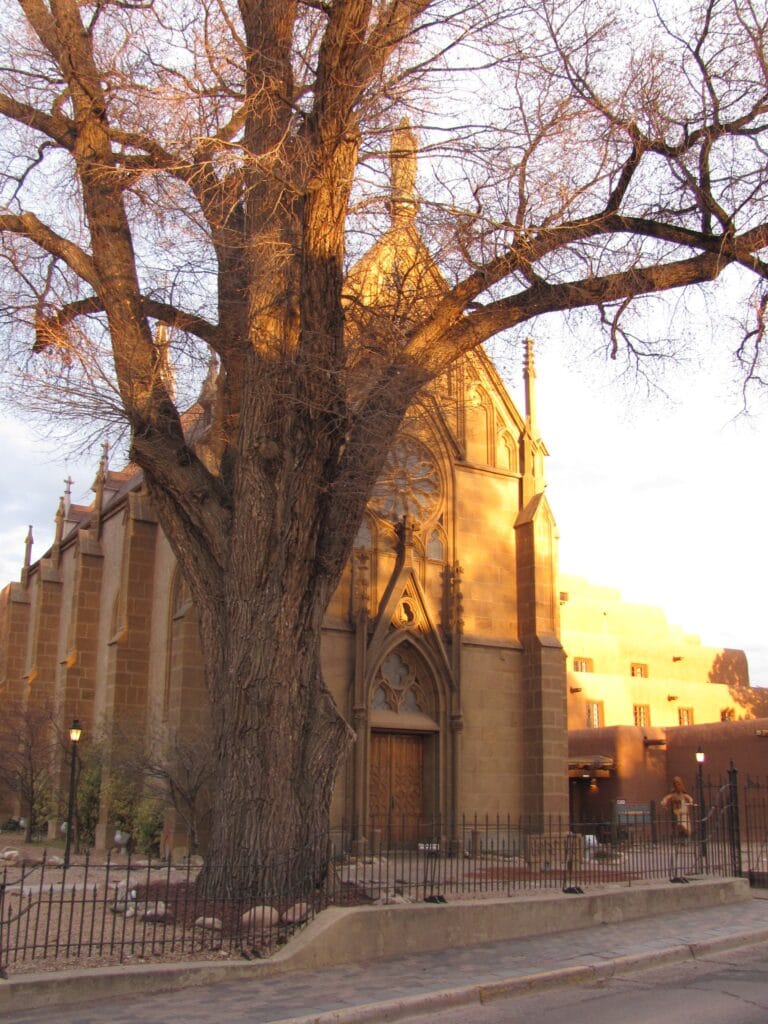
The Loretto Chapel is a Gothic Revival chapel best known for its Miraculous Staircase, an extraordinary wooden stairway constructed without a conventional central support.
Religious tradition credits the mysterious carpenter as Saint Joseph, while historical research points to French carpenter François Jean Rochas. The chapel remains one of Santa Fe’s most recognizable sacred landmarks and architectural mysteries.
Sacred Significance
The chapel was constructed for the Sisters of Loretto and dedicated as the Chapel of Our Lady of Light. Its religious importance is closely connected to the Sisters’ educational mission in New Mexico and the tradition surrounding its remarkable staircase.
According to the chapel’s legend, the Sisters prayed a nine day novena to Saint Joseph, the patron saint of carpenters, after discovering that the choir loft had no practical staircase.
On the final day of their prayers, an unknown carpenter reportedly arrived and offered to complete the work.
The carpenter was said to have worked privately using simple tools. After completing the staircase, he disappeared without requesting payment or identifying himself.
Unable to locate the man, the Sisters reportedly concluded that Saint Joseph had answered their prayers.
History
During the 1850s, Bishop Jean Baptiste Lamy invited members of the Sisters of Loretto to establish a school in Santa Fe.
The Sisters endured a difficult journey from Kentucky and founded the Academy of Our Lady of Light.
Construction of the chapel began during the 1870s. Designed in the Gothic Revival style, the building stood apart from Santa Fe’s more familiar adobe and Pueblo influenced architecture.
The chapel was completed in 1878 and was modeled in part after Sainte Chapelle in Paris.
When the building was nearly finished, access to the elevated choir loft presented a serious problem. A conventional staircase would have occupied too much space inside the relatively small chapel.
The resulting spiral staircase rose approximately 20 feet while making two complete turns.
The chapel ceased operating as the Sisters’ institutional church after much of the surrounding property was sold in 1971. It is now privately operated as a museum and wedding chapel.
The Miraculous Staircase
The staircase makes two complete 360 degree turns without a conventional central pole or newel.
Its inner wooden stringer forms a tight spiral and provides part of the staircase’s structural support. The outer stringer provides additional support.
The original staircase reportedly had no railing. A railing and additional structural support were added later for safety and stability.
The staircase contains 33 steps. This number is sometimes connected symbolically with the traditional age of Jesus at the time of his death, although the number alone does not prove a religious intention in the design.
The staircase is sometimes described as having been built entirely without nails. More accurately, its original construction relied heavily on wooden pegs and traditional woodworking joints.
Several aspects of the staircase remain debated, including the identity of its carpenter and the precise source of its wood.
The Mysterious Carpenter
The traditional account describes the builder as an unknown elderly carpenter who appeared after the Sisters completed their novena to Saint Joseph.
He reportedly arrived with a donkey and a small collection of simple tools. He asked to work privately and completed the staircase without revealing his identity.
After the staircase was completed, the carpenter disappeared before he could be paid. Attempts to locate him were reportedly unsuccessful.
Historical research has identified François Jean Rochas, a skilled French carpenter living in New Mexico, as the most likely builder.
The National Park Service notes that available evidence points to Rochas. However, the religious tradition crediting Saint Joseph remains an important part of the chapel’s identity.
Identifying a likely carpenter does not eliminate the staircase’s religious meaning. Many believers understand the timing of his arrival and the successful construction as the answer to the Sisters’ prayers.
Legends, Miracles, and Unusual Features
The chapel’s central legend describes the staircase as an answer to the Sisters’ novena to Saint Joseph.
Its mysterious builder, unusual construction, tightly curved wooden components, and lack of an obvious central support helped establish its miraculous reputation.
Another mystery concerns the wood used in the staircase. Popular accounts claim that the wood could not be identified or was unavailable in the region. The exact botanical claims vary and should be treated cautiously because they have not been conclusively established.
No supernatural explanation is required for the staircase to remain standing. Its inner and outer stringers act as curved structural supports.
Even with an engineering explanation, the staircase remains an exceptional example of skilled carpentry created inside a confined space.
Visitors may interpret the story as a miracle, an answer to prayer, a masterpiece of human craftsmanship, or a combination of faith and skill.
Reported Spiritual and Paranormal Experiences
The Loretto Chapel is primarily associated with a religious miracle and architectural mystery rather than a strong haunted reputation.
Visitors occasionally describe experiencing unusual peacefulness, emotional intensity, a sense of presence, or a powerful spiritual atmosphere inside the chapel.
Some accounts mention unexplained sounds, shadows, or unusual sensations. These reports are anecdotal and do not establish a consistent pattern of paranormal activity.
There is no well documented history of threatening apparitions, hostile entities, or dangerous supernatural disturbances at the chapel.
Environmental conditions, architecture, acoustics, expectation, personal faith, and emotional responses may all influence a visitor’s experience.
A respectful investigation may examine the chapel’s history, architecture, acoustics, environmental conditions, religious tradition, and reported visitor experiences.
Organized paranormal or spiritual investigations require advance permission from the property. Investigators must follow tour rules, remain within authorized areas, and avoid interfering with weddings, worship, staff, or other visitors.
Why This Place Is Unique
The Loretto Chapel brings together prayer, religious tradition, architectural skill, historical investigation, and an enduring mystery.
The Miraculous Staircase provides visitors with a physical object they can examine. Its unusual shape, compact design, craftsmanship, and uncertain history continue to inspire questions.
The legend is considered benevolent rather than frightening. It centers on an apparent answer to prayer and the arrival of a carpenter when the Sisters needed help.
The historical identification of François Jean Rochas adds another layer to the story without erasing its spiritual meaning.
Few sacred sites contain such a recognizable structure whose history can be explored through faith, engineering, architecture, and historical evidence at the same time.
Investigation Guidelines
Historical, architectural, spiritual, and paranormal research may be conducted only within the property’s rules.
An ordinary admission ticket does not authorize a formal investigation, private access, specialized equipment, after hours access, or entry into restricted areas.
Organized investigations require advance permission from the property’s management.
Investigators should use quiet and noninvasive methods. Equipment must not obstruct walkways, interfere with tours, or be attached to the staircase, walls, furniture, or religious objects.
Investigators must not touch or climb the Miraculous Staircase.
Weddings, ceremonies, prayers, and private religious experiences must not be interrupted, photographed, or recorded without permission.
Spirit provocation, unauthorized séances, fires, candles, incense, offerings, and attempts to summon entities are not appropriate without explicit authorization.
Reports should clearly distinguish between historical evidence, religious tradition, personal experience, environmental observations, and unverified paranormal interpretations.
Visitor Information
The Loretto Chapel operates as a privately owned museum and wedding venue.
Public access, admission prices, ceremonies, and operating hours may change. Visitors should consult the chapel’s official website before traveling.
The chapel may close temporarily for weddings, private events, maintenance, or religious observances.
Visitors must remain within designated public areas and follow all instructions from chapel staff.
The Miraculous Staircase may be viewed but is not open for visitors to climb.
Private access, after hours visits, overnight investigations, and specialized tours should never be assumed to be available. Visitors must receive direct authorization from the property.
Respect and Cultural Restrictions
The chapel was created as a Catholic place of worship and continues to hold religious meaning for many people.
Visitors should speak quietly, dress respectfully, and avoid interrupting ceremonies, prayers, weddings, or private moments.
Guests must not touch or climb the staircase, enter restricted areas, handle religious objects, or conduct an organized investigation without advance permission.
Any approved investigation must remain quiet, noninvasive, and respectful of the chapel’s religious significance.
Religious traditions and reported miracles should be identified as matters of faith rather than presented as scientifically proven or disproven facts.
Photography Restrictions
Photography policies may change during weddings, ceremonies, and private events. Visitors should confirm current rules with chapel staff.
Professional photography, commercial filming, tripods, lighting equipment, organized photo sessions, and investigation recordings may require advance permission.
Visitors should never photograph or record weddings, ceremonies, worshippers, or private religious activities without authorization.
Photography must not be used as a reason to touch the staircase, block walkways, leave a tour, or enter restricted areas.
Accessibility
The historic building and its staircase were not designed according to modern accessibility standards.
Visitors with mobility, vision, hearing, or other accessibility needs should contact the chapel before arriving to confirm accessible entrances and viewing arrangements.
The Miraculous Staircase is not available for public climbing.
Official Website
Loretto Chapel Official Website
Mystera Classification
Sacred: Yes
Active Place of Worship: Used for weddings and religious occasions, although it primarily operates as a museum and event venue
Architecturally Unique: Yes
Associated With a Miracle: Yes, according to religious tradition
Haunted: Not established
Reported Spiritual Experiences: Yes
Reported Paranormal Experiences: Anecdotal and unverified
Paranormal or Spiritual Investigation: Formal investigations require advance permission from the property. Ordinary visitors may document publicly available history and personal experiences while following tour rules and respecting religious activities.
Publicly Accessible: Yes, subject to admission requirements, tours, private events, and property restrictions
Sources and Image Credit
Loretto Chapel Official Website
National Park Service: Loretto Chapel
Tourism Santa Fe: Loretto Chapel
Photograph: “Loretto Chapel, Santa Fe, New Mexico” by John Phelan. Licensed under Creative Commons Attribution 3.0. View and download the original photograph and license information.
© 2026 Mystera Headquarters. All rights reserved.