Dendritic Agate
Article
Images
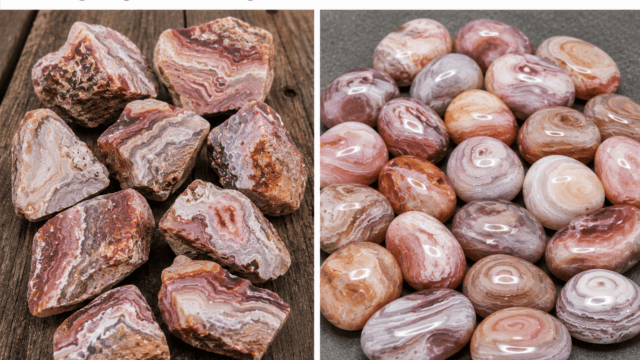
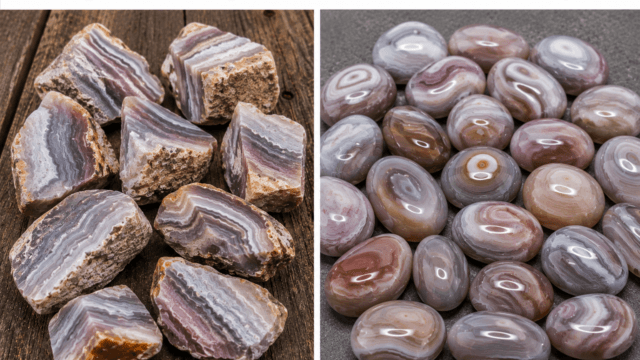
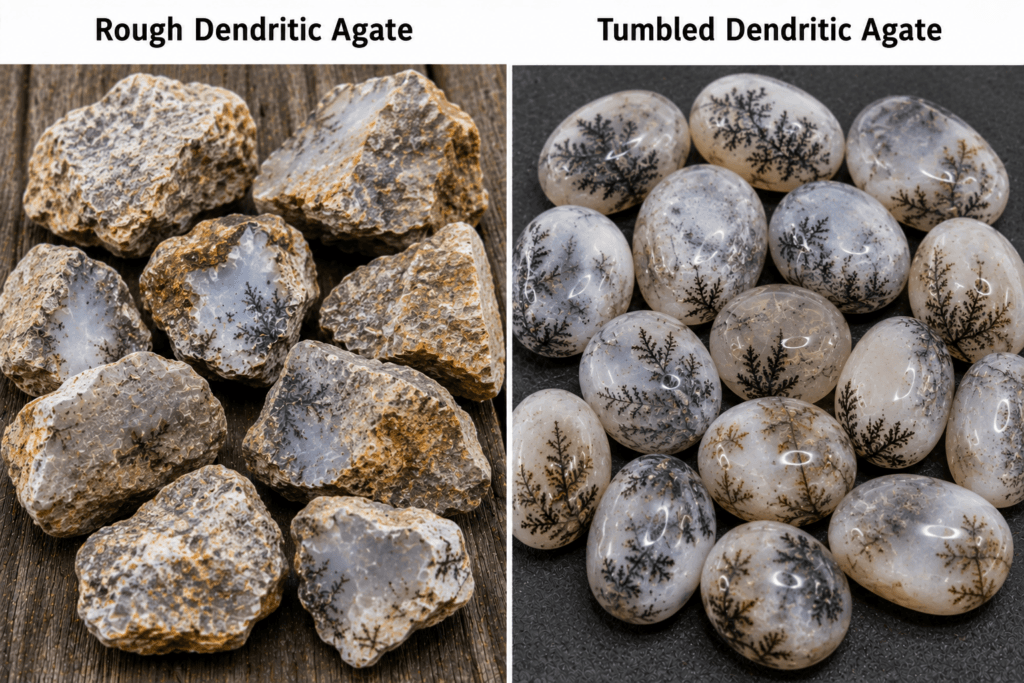
Rough Dendritic Agate
Polished/Tumbled Dendritic Agate
At a Glance
Also Known As: Tree Agate (sometimes confused with Dendritic Agate, although they are not always the same material)
Mineral Family: Quartz (Chalcedony)
Chemical Formula: SiO₂
Crystal System: Trigonal (Microcrystalline)
Mohs Hardness: 6.5 to 7
Color(s): Clear, translucent, white, cream, gray, pale brown, and occasionally pale yellow, with black, brown, reddish, or greenish branching inclusions
Primary Chakra(s): Root Chakra
Secondary Chakra(s): Heart Chakra
Zodiac Sign(s): Gemini, Virgo
Toxic: Generally considered non-toxic for normal handling
Water Safe: Generally yes for brief contact when natural and untreated
Elixir Safe: Indirect method recommended because the branching inclusions can contain manganese or iron minerals and individual specimens may contain additional unknown inclusions or treatments.
Overview
Dendritic Agate is a distinctive form of chalcedony recognized by branching mineral patterns that resemble trees, ferns, roots, moss, or miniature landscapes trapped within the stone. These natural formations are called dendrites.
Despite their plant-like appearance, the dendrites are not fossilized plants. They are mineral deposits that developed within tiny fractures and spaces in the chalcedony.
Dendritic Agate can range from nearly transparent to milky white or pale gray, allowing the dark branching patterns inside the stone to become its most striking feature.
Within metaphysical traditions, Dendritic Agate is strongly associated with connection to nature, grounding, patience, personal growth, abundance, and developing strong roots while continuing to expand.
Formation & Geological Information
Dendritic Agate forms from chalcedony, a microcrystalline variety of quartz.
After the chalcedony forms, mineral-rich solutions can travel through microscopic fractures and spaces within the stone. Minerals, most commonly manganese oxides and sometimes iron oxides, crystallize along these pathways.
The resulting deposits branch outward in patterns known as dendrites.
Because dendritic growth follows tiny natural fractures and pathways within the stone, the resulting formations can look remarkably similar to trees, roots, leaves, or other organic structures even though no plant material is involved.
Strictly speaking, some material sold as Dendritic Agate may lack the banding traditionally used to define true agate. The name remains widely established in the gemstone, lapidary, and metaphysical trades.
Where It Is Found
Dendritic Agate occurs in several locations around the world, including:
India
Brazil
United States
Mexico
Madagascar
Kazakhstan
Australia
Individual deposits can produce dramatically different colors and dendritic patterns.
Metaphysical & Spiritual Associations
Keywords: Growth • Nature • Grounding • Abundance • Patience • Stability • Connection • Perseverance • Inner Strength
Dendritic Agate is deeply associated with nature and the process of growth. Its tree-like inclusions have made it a powerful symbol of roots, branches, expansion, and the interconnected cycles of life.
Metaphysically, it is often chosen by people who want to grow without losing their foundation. Like a tree that reaches upward while remaining firmly rooted below, Dendritic Agate represents the balance between expanding into something new and staying connected to what keeps us grounded.
It is traditionally associated with patience because meaningful growth rarely happens instantly. Practitioners may work with Dendritic Agate when developing a new skill, building a business, changing long-standing habits, beginning a spiritual practice, or pursuing goals that require consistent effort over time.
The stone is also strongly connected with abundance. In this context, abundance does not necessarily refer only to money. It can represent opportunities, relationships, creativity, knowledge, personal fulfillment, and recognizing the resources already present in one’s life.
Dendritic Agate may also be chosen during periods when someone feels disconnected from nature or overly consumed by technology, responsibilities, or mental activity. Its natural imagery can serve as a reminder to reconnect with the physical world and the rhythms of the Earth.
For spiritual growth, Dendritic Agate is associated with developing gradually and allowing experiences to unfold naturally rather than forcing immediate results.
Its branching patterns can also symbolize connection. One path becomes many branches, yet everything remains connected to the same source. Because of this symbolism, some practitioners associate the stone with ancestry, family roots, generational patterns, and understanding how the past influences the present.
Within paranormal and intuitive work, Dendritic Agate may be especially meaningful when investigating locations connected with land, historical events, ancestral energy, or natural environments. Some practitioners use it as a grounding stone when attempting to distinguish impressions associated with a location from their own emotional responses.
It may also be used during psychometry, meditation, ancestral work, or intuitive exploration involving the history of land and place.
Chakra Associations
Dendritic Agate is primarily associated with the Root Chakra, which represents grounding, stability, security, physical presence, and connection to the Earth.
Its tree and root-like patterns reinforce this association symbolically.
It is also commonly connected with the Heart Chakra, particularly when the dendrites appear green or when the stone is being used for nature-based spiritual practices.
Together, these chakra associations represent the idea of being firmly grounded while continuing to grow emotionally and spiritually.
Zodiac Associations
Dendritic Agate is commonly associated with Gemini and Virgo in modern metaphysical traditions.
Virgo is traditionally connected with the Earth, patience, practical growth, organization, and tending carefully to what is being created. These qualities align naturally with Dendritic Agate’s symbolism of steady development.
Gemini is associated with curiosity, learning, connection, and branching into new ideas and experiences. The complex dendritic patterns can symbolically reflect this expanding network of knowledge and connection.
Zodiac correspondences vary among metaphysical traditions, so these associations should be viewed as traditional connections rather than fixed rules.
Traditional Wellness Associations
Within crystal healing traditions, Dendritic Agate is associated with grounding, emotional stability, relaxation, patience, and creating a stronger sense of connection with nature.
Some traditional crystal healing systems also associate it with the body’s natural cycles of growth, renewal, and physical vitality.
These are metaphysical associations and do not indicate that Dendritic Agate can treat medical or psychological conditions.
Disclaimer: Crystal healing is a spiritual practice and is not intended to diagnose, treat, cure, or prevent any medical condition. It should never replace professional medical advice, diagnosis, or treatment.
Safety
Toxicity: Dendritic Agate is generally considered safe for normal handling.
Water Safety: Natural, untreated Dendritic Agate is generally considered safe for brief contact with water.
Elixir Safety: The indirect method is recommended. The dendritic formations commonly contain manganese or iron minerals, and individual specimens can contain additional inclusions or treatments. Keeping the stone physically separate from drinking water removes unnecessary uncertainty.
Sunlight: Natural Dendritic Agate is generally stable under normal light conditions. Prolonged intense sunlight should be avoided if the treatment history of a specimen is unknown.
Buying Tips
Look for clear, well-defined branching patterns that appear naturally embedded within the stone. Dendrites may resemble trees, ferns, roots, moss, feathers, or miniature landscapes.
The most desirable specimens often have strong contrast between the background chalcedony and the dendritic inclusions.
Remember that the branching patterns are mineral formations, not fossilized plants.
Dendritic Agate is sometimes confused with Moss Agate and Tree Agate. Moss Agate typically contains more irregular moss-like inclusions, while Dendritic Agate is characterized by more distinct branching or tree-like formations.
Did You Know?
The word dendritic comes from the Greek word dendron, meaning “tree.” The term is used in science to describe branching structures, including mineral formations, neurons in the brain, river systems, and even patterns created by frost.
Mystera Insight
Dendritic Agate carries one of nature’s most powerful lessons. A tree does not question whether it is growing fast enough. It develops roots, reaches toward the light, adapts to its environment, and grows in its own time. Our path can unfold the same way. Strong roots do not prevent us from expanding. They are what allow us to reach higher.
Related Crystals
Moss Agate
Tree Agate
Botswana Agate
Picture Jasper
Petrified Wood
Garden Quartz
Green Aventurine