Chaco Culture National Historical Park
Section
Listing Name: Chaco Culture National Historical Park
Alternative Names: Chaco Canyon, Chaco Culture, Chaco
Category: Sacred Indigenous Landscape, Archaeological Site, Ancient Ceremonial Center, Astronomical Site, National Historical Park, World Heritage Site
Cultural Tradition: Ancestral Puebloan, with continuing cultural and spiritual connections to modern Pueblo peoples, the Hopi Tribe, and the Navajo Nation
Mystery Level: High Sacred Mystery
Country: United States
State: New Mexico
Counties: San Juan County and McKinley County
Nearest Community: Nageezi
Physical Address:
1808 County Road 7950
Nageezi, NM 87037
United States
Latitude: 36.060640
Longitude: -107.963470
Short Description
Chaco Culture National Historical Park preserves one of the most important ancestral Puebloan cultural landscapes in the American Southwest. Between approximately A.D. 850 and 1250, Chaco became a major center of ceremony, trade, architecture, astronomy, and regional connection.
The canyon contains monumental great houses, ceremonial kivas, engineered roads, stairways carved into cliffs, water control systems, petroglyphs, pictographs, and structures connected with the movements of the sun and moon. Many mysteries remain concerning how Chaco was governed, how its buildings were used, why construction declined, and how its extensive regional system functioned.
Chaco Canyon remains a sacred ancestral homeland with living spiritual importance. It is not an abandoned or forgotten civilization.
Sacred Significance
Pueblo descendants describe Chaco as a special gathering place where different peoples and clans came together to share ceremonies, traditions, knowledge, and resources.
Many Southwestern Indigenous people regard Chaco as an important location along sacred migration paths. Its great houses, mesas, shrines, roads, and other landscape features remain spiritually meaningful.
The Hopi, Pueblo peoples of New Mexico, and the Navajo Nation maintain distinct histories, names, traditions, and relationships with the canyon. Some sacred place names and cultural information are intentionally kept private.
Visitors and investigators should understand that not every feature at Chaco is meant to be fully explained to the public. Respecting cultural privacy is part of respecting the site.
History
People lived in the Chaco Canyon region for thousands of years before the construction of its monumental great houses.
Beginning in the middle of the ninth century, ancestral Puebloan builders developed large masonry structures with carefully planned rooms, plazas, and ceremonial spaces. Construction continued for several centuries.
Chaco became a center within a regional system that extended across much of the present American Southwest. Communities were connected through architecture, trade, ceremonial traditions, and a network of roads.
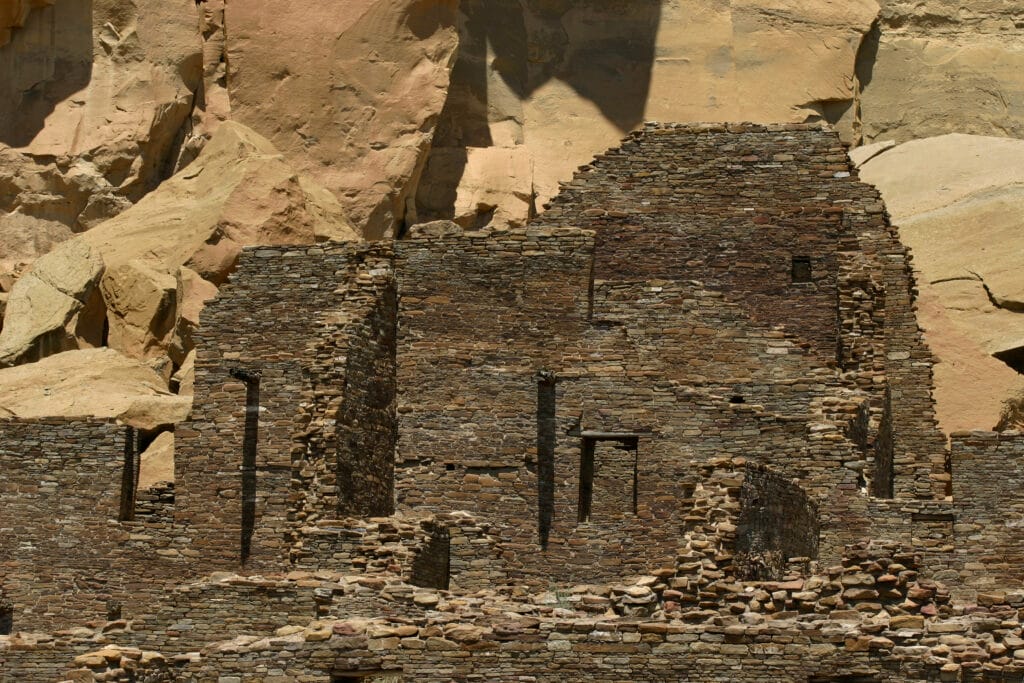
Builders transported timber into the canyon from distant mountain ranges. They shaped sandstone into carefully fitted masonry walls and constructed buildings containing hundreds of rooms.
The canyon’s largest great houses included Pueblo Bonito, Chetro Ketl, Una Vida, Pueblo del Arroyo, Hungo Pavi, and Kin Kletso. Pueblo Bonito became the best known and one of the most complex structures in the canyon.
Major construction slowed during the late eleventh and twelfth centuries. Chaco’s role as a regional center gradually changed, and people moved into other areas of the Southwest.
Drought, environmental pressures, social changes, shifting religious traditions, and political developments may all have influenced the transformation. No single explanation has been proven to account for every change.
The descendants of Chaco’s people did not disappear. Their cultures continued and developed into the living Pueblo communities of the Southwest.
The United States established Chaco Canyon National Monument in 1907. It became Chaco Culture National Historical Park in 1980 and was designated a UNESCO World Heritage Site in 1987.
The Great Houses
Chaco’s great houses were much larger and more carefully planned than ordinary residential structures of the same period.
Pueblo Bonito contained hundreds of rooms and rose several stories in some areas. Its curved outer wall and organized interior created a distinctive shape when viewed from above.
Many great houses contain kivas, which are circular spaces associated with gathering, ceremony, teaching, and community life. Larger spaces known as great kivas may have served broader ceremonial or social purposes.
Researchers continue to debate how many people lived permanently inside the great houses. Some evidence suggests that portions of the buildings were used for ceremony, storage, gatherings, political activities, or visits rather than ordinary daily residence.
The precise purposes of individual rooms and structures may never be completely known. Archaeological interpretations do not replace the cultural knowledge and oral traditions of descendant communities.
Astronomy and the Sky
The builders of Chaco carefully observed the sky. Architectural orientations and landscape features reflect knowledge of solar, lunar, and stellar cycles.
Some buildings were positioned in relation to seasonal sunrises and sunsets. Calendrical markings in the wider landscape may have helped track important solar and lunar events.
The most famous astronomical feature is associated with Fajada Butte, where shaped stones and carved spiral designs interacted with sunlight at significant times of the year. Access to this feature is restricted to protect it from additional damage.
Researchers have also examined possible lunar alignments connected with the long cycle of the moon. Some proposed alignments are strongly supported, while others remain debated.
The clear night sky continues to be an important part of the Chaco experience. The park offers astronomy programs and opportunities to observe the stars when staffing, weather, and schedules permit.
The Chacoan Roads
A network of remarkably straight roads extended from Chaco’s great houses toward distant communities and landscape features.
Some roads continued across difficult terrain instead of following the easiest natural routes. Builders created ramps, stairways, and other features to maintain their direction.
The roads may have supported travel, trade, communication, pilgrimage, ceremonies, or symbolic connections between communities and sacred places. Different roads may have served different purposes.
The full extent and meaning of the Chacoan road system remain among the canyon’s most important mysteries.
Trade and Distant Connections
Objects discovered at Chaco reveal connections extending far beyond the canyon.
Turquoise, shells, copper bells, and other materials reached Chaco through extensive exchange networks. Some objects originated in areas hundreds of miles away.
The presence of cacao and birds associated with regions farther south demonstrates connections with cultures in what is now Mexico.
These discoveries show that Chaco was not an isolated settlement. It formed part of a complex world of movement, trade, ceremony, and shared knowledge.
Legends and Unusual Experiences
Many visitors describe Chaco as unusually quiet, powerful, emotionally intense, or spiritually charged. The canyon’s isolation, monumental architecture, open landscape, and dark sky can create a profound experience.
Some people report feeling a strong presence near Pueblo Bonito, the great kivas, Fajada Butte, and other locations. Others describe vivid dreams, sudden emotional reactions, unusual silence, or an altered sense of time.
These accounts are personal experiences rather than scientifically verified phenomena. They may arise from spirituality, expectation, environmental conditions, the canyon’s isolation, or a combination of influences.
Chaco’s established mysteries involve its architecture, astronomy, roads, ceremonies, political organization, population, and transformation. These unanswered questions provide substantial mystery without requiring supernatural explanations.
Reported Paranormal Activity
Chaco Canyon is not primarily known as a haunted location. Its reputation centers on sacred history, ancestral presence, archaeological mystery, and the powerful atmosphere of the landscape.
Anecdotal stories occasionally describe unexplained lights, distant voices, footsteps, shadowy movement, or the feeling of being watched. These reports are inconsistent and have not been established as reliable evidence of paranormal activity.
Wildlife, wind, echoes, darkness, distance, temperature changes, and limited artificial lighting can produce unfamiliar sensations and sounds.
A respectful investigation may focus on the site’s history, architecture, astronomy, oral traditions, environmental conditions, and reported visitor experiences.
Any organized paranormal or spiritual investigation requires advance permission from the National Park Service and must respect Indigenous cultural boundaries. Investigators must not enter closed areas, disturb archaeological features, attempt to summon spirits, leave offerings, or record private ceremonies and sacred knowledge.
Why This Place Is Unique
Chaco Culture National Historical Park combines monumental architecture, astronomy, sacred geography, engineering, trade, and living cultural connections on an extraordinary scale.
The canyon contains evidence of a regional system that influenced communities across a vast area. Its roads and great houses demonstrate remarkable planning, organization, labor, and knowledge.
Many central questions remain unanswered. Researchers continue to study who occupied particular buildings, how ceremonies were organized, what authority existed at Chaco, why certain roads were built, and how environmental and social changes transformed the region.
The most important feature of Chaco is its continuing meaning. It is both an archaeological landscape and a sacred ancestral homeland connected to living Indigenous communities.
Investigation Guidelines
Investigators must follow the same laws, access rules, and cultural restrictions that apply to every visitor. A research or paranormal purpose does not authorize entry into closed areas or access outside operating hours.
Formal permission may be required for organized investigations, groups, specialized equipment, audio recording, nighttime access, exclusive use, or activities extending beyond an ordinary visit.
Investigations should use noninvasive methods. Equipment must not be attached to walls, placed on archaeological features, or positioned where it could obstruct paths or affect other visitors.
Historical and environmental research can include documenting weather, wind, temperature, acoustics, lighting, wildlife, architecture, personal impressions, and publicly available oral histories.
Investigators should not attempt to provoke, command, challenge, or summon spirits. They should not imitate ceremonies or use Indigenous prayers, songs, symbols, or sacred practices without authorization.
Private ceremonies, restricted locations, burials, offerings, and culturally sensitive knowledge must not be photographed, recorded, investigated, or disclosed.
Any findings should clearly separate measured observations, personal experiences, local traditions, and unverified interpretations.
Visitor Information
Chaco Culture National Historical Park is remote and can only be reached by roads containing long unpaved sections. These roads may become rough, muddy, or impassable during rain or snow.
Visitors should follow the National Park Service’s official directions. Some navigation systems may recommend unsafe roads or routes crossing private property.
The north entrance includes approximately 13 miles of unpaved road. The south entrance includes approximately 21 miles of unpaved road. Conditions may change quickly.
The park currently operates with seasonal hours. From May 1 through October 31, archaeological sites and trails are normally open from 7:00 a.m. until 9:00 p.m. From November 1 through February 28, they are normally open from 7:00 a.m. until 5:00 p.m. From March 1 through April 30, they are normally open from 7:00 a.m. until 7:00 p.m.
The entrance gate to the loop road closes 30 minutes before the park closes. The visitor center is normally open daily from 9:00 a.m. until 5:00 p.m.
The park closes on Thanksgiving, Christmas Day, and New Year’s Day. Hours and access may change, so visitors should verify current conditions before traveling.
All visitors must have an entrance pass. Camping at Gallo Campground requires a campsite, and reservations are strongly recommended.
There is no public transportation to the park. Cellular service is limited, and public internet service is not available. Visitors should arrive with adequate fuel, drinking water, food, weather protection, and emergency supplies.
Respect and Cultural Restrictions
Visitors must remain on designated paths and follow all posted closures. Climbing, sitting, standing, or walking on archaeological walls is prohibited.
Artifacts, stones, pottery fragments, plants, soil, and other materials must remain where they are found. Digging, metal detecting, graffiti, and disturbance of archaeological features are illegal.
Visitors must not enter closed rooms, restricted areas, burial locations, shrines, or culturally sensitive sites.
Offerings, ashes, candles, fires, substances, and other objects should not be left without authorization. Even well intended actions can damage archaeological resources or conflict with the traditions of descendant communities.
Visitors and investigators should not demand explanations of sacred knowledge that communities have chosen to keep private.
The access roads cross private tribal lands. Travelers must remain on the authorized route, respect local residents and livestock, and avoid trespassing.
Photography Restrictions
Ordinary personal photography is generally permitted in areas open to the public when it does not damage resources or interfere with visitors.
Photography, filming, and audio recording involving eight or fewer people usually do not require a permit when participants remain in public areas, use hand carried equipment, do not require exclusive access, and do not create additional impacts or costs.
Larger productions, special access, organized events, exclusive use, or activities that could affect park resources may require advance authorization.
Drones are prohibited in National Park Service areas.
Photography must not be used as a reason to enter closed areas, climb structures, disturb cultural objects, or interfere with ceremonies and authorized cultural activities.
Accessibility
The visitor center and some facilities provide accessible services. Conditions at individual great houses and trails vary.
Visitors may encounter uneven ground, stone surfaces, sand, steps, narrow passages, and changes in elevation. Some archaeological areas may not be fully accessible.
Visitors with mobility, vision, hearing, or other accessibility needs should contact the park before traveling to discuss current accommodations and conditions.
Official Website
National Park Service: Chaco Culture National Historical Park
Mystera Classification
Sacred: Yes
Active Place of Worship: Sacred practices and cultural connections continue, although the park is not a conventional public house of worship
Indigenous Cultural Site: Yes
Archaeologically Unique: Yes
Astronomically Significant: Yes
World Heritage Site: Yes
Associated With Burials: Yes
Haunted: Not established
Reported Spiritual Experiences: Yes
Reported Paranormal Experiences: Anecdotal and unverified
Paranormal or Spiritual Investigation: Only with formal permission, lawful access, culturally respectful methods, and no disturbance of sacred or archaeological resources
Publicly Accessible: Yes, during official operating hours and subject to closures
Sources and Image Credit
National Park Service: Chaco Culture National Historical Park
National Park Service: Chaco History and Culture
National Park Service: Chaco Culture and Its Sacred Importance
National Park Service: Chaco Canyon Place Names
National Park Service: Operating Hours and Seasons
National Park Service: Directions and Road Information
National Park Service: Photography, Filming, and Special Use Permits
Photograph: “Chaco Pueblo Bonito” by Steven C. Price. Licensed under Creative Commons Attribution-ShareAlike 3.0. View and download the original photograph and license information.
© 2026 Mystera Headquarters. All rights reserved.