
Cahokia Mounds State Historic Site
Section
Listing Name: Cahokia Mounds State Historic Site
Alternative Names: Cahokia, Cahokia Mounds, Ancient Cahokia
Category: Sacred Indigenous Landscape, Ancient City, Archaeological Site, Ceremonial Center, Astronomical Site, World Heritage Site
Cultural Tradition: Mississippian culture, with continuing cultural importance to living Indigenous peoples
Mystery Level: High Sacred Mystery
Country: United States
State: Illinois
County: St. Clair County
City: Collinsville
Address:
30 Ramey Street
Collinsville, IL 62234
United States
Latitude: 38.654853
Longitude: -90.059277
Short Description
Cahokia Mounds State Historic Site preserves the remains of the largest ancient Indigenous city north of Mexico.
At its height between approximately A.D. 1050 and 1200, Cahokia contained monumental earthworks, neighborhoods, plazas, ceremonial buildings, defensive walls, agricultural areas, and wooden circles aligned with the movement of the sun.
The site contains Monks Mound, the largest Indigenous earthen structure north of Mexico. It also contains burial mounds and the reconstructed Woodhenge solar calendar.
Cahokia’s original name, social organization, religious traditions, and reasons for its transformation remain partly unknown. The site continues to hold cultural and spiritual importance for Indigenous peoples.
Sacred Significance
Cahokia was more than a large settlement. It was a ceremonial, political, economic, and cultural center within the Mississippian world.
Its mounds supported important buildings, marked burial locations, organized public space, and formed part of a sacred landscape.
The city’s design connected people with the earth, the sky, the seasons, community life, leadership, and religious ceremony.
Woodhenge demonstrates that Cahokia’s people carefully observed the movement of the sun. Important events may have been scheduled according to seasonal cycles marked by sunrise positions.
The surviving mounds are sacred cultural features rather than ordinary hills. Some contain human burials and must be treated with the same respect given to cemeteries and memorials.
The people who built Cahokia did not vanish. Indigenous nations throughout the region preserve cultural connections with the wider Mississippian world and its traditions.
History
People lived in the Mississippi River region for thousands of years before Cahokia became a major city.
Around A.D. 1050, Cahokia experienced rapid growth. New neighborhoods, plazas, ceremonial areas, and monumental earthworks transformed the landscape.
At its height, Cahokia may have contained between 10,000 and 20,000 residents. When nearby settlements are included, the larger population may have reached tens of thousands.
The original city covered more than 4,000 acres and included approximately 120 mounds. The protected historic site preserves a portion of this much larger landscape.
Cahokia’s residents cultivated maize and other crops, hunted, fished, produced art, created tools, conducted ceremonies, and participated in extensive exchange networks.
Materials and objects traveled to Cahokia from distant regions. Its influence extended throughout much of the Mississippi Valley and southeastern North America.
The city began changing after approximately A.D. 1200. Its population gradually declined, and the area was largely depopulated by around A.D. 1400.
Researchers have proposed several possible causes, including climate changes, flooding, drought, disease, environmental pressure, political conflict, social inequality, migration, and changes in religious or community organization.
No single explanation has been proven to account for Cahokia’s transformation.
European settlers later encountered the abandoned earthworks without knowing the city’s original name. The modern name Cahokia came from an Indigenous community living in the wider region during a later period.
Cahokia Mounds became a National Historic Landmark in 1965 and a UNESCO World Heritage Site in 1982.
Monks Mound
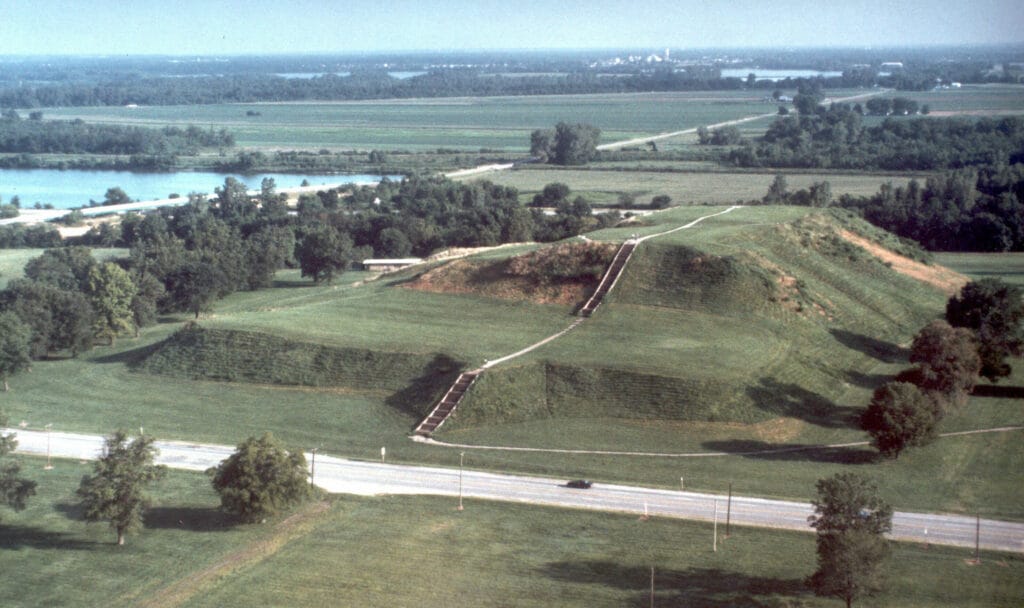
Monks Mound is the largest earthwork at Cahokia and the largest Indigenous earthen structure north of Mexico.
It rises approximately 100 feet and covers about 14 acres at its base. Its footprint is comparable in size to some of the world’s largest ancient monuments.
The mound was constructed in stages using layers of soil carried by hand in baskets. Its builders moved an enormous amount of earth without modern vehicles or machinery.
A large building once stood on the summit. It may have served as the residence of an important leader, a ceremonial structure, a council building, or a place combining several functions.
The modern name comes from Trappist monks who lived near the mound during the early nineteenth century. The name is not connected with the people who originally built it.
Visitors may climb Monks Mound using the designated stairs and paths. Leaving the authorized route can damage the ancient structure.
The Grand Plaza
A large open area known as the Grand Plaza extended south of Monks Mound.
The plaza may have hosted ceremonies, public gatherings, games, markets, political events, and community activities.
Archaeological evidence suggests that Cahokia’s builders deliberately leveled and prepared the area. Creating such a large flat space required considerable planning and labor.
The relationship between Monks Mound, the Grand Plaza, surrounding mounds, and Woodhenge demonstrates that Cahokia was carefully organized rather than developing randomly.
Woodhenge
West of Monks Mound, archaeologists discovered evidence of several large circles made from wooden posts.
The reconstructed circle is commonly called Woodhenge because of its general resemblance to circular monuments found elsewhere in the world.
When viewed from a central observation point, selected posts align with the rising sun near the solstices and equinoxes.
The alignments may have helped Cahokia’s people track agricultural seasons, schedule ceremonies, organize public gatherings, or confirm the ritual calendar.
Woodhenge was rebuilt several times in different sizes. These changes suggest that astronomical observation and ceremonial planning remained important over generations.
The reconstructed posts help modern visitors understand the alignments, but they are not the original wooden structures.
Mound 72 and Burials
Mound 72 is one of Cahokia’s most important and sensitive archaeological areas.
Excavations revealed numerous burials, ceremonial objects, and evidence of complex mortuary practices. Hundreds of individuals were interred within or near the mound during different events.
Some burials appear to have involved people of high status, while others may reflect sacrifice, execution, violence, or other practices that remain debated.
Older interpretations sometimes presented a simple story involving a single powerful male ruler. Later research has challenged parts of that interpretation and shown that the burial history was more complicated.
Mound 72 is a burial place and must be treated as a cemetery. Paranormal entertainment, provocation, digging, unauthorized ceremonies, and disturbance are not acceptable.
Astronomy and Landscape Design
Cahokia’s builders organized parts of the city in relation to cardinal directions and celestial events.
Woodhenge provides the clearest evidence of solar observation. The sunrise alignments identify important seasonal points in the year.
The positions of mounds, plazas, buildings, and pathways may also have reflected ceremonial relationships between the earth, sky, community, and sacred directions.
Researchers continue to debate how much of Cahokia’s overall layout was based on astronomical planning.
The surviving evidence demonstrates careful observation and engineering, but the complete spiritual meaning of the design is not known.
The Mystery of Cahokia’s Transformation
Cahokia’s population declined after generations of growth and monumental construction.
Climate shifts may have affected crops and water supplies. Flooding and drought may have placed additional pressure on the city.
The demand for timber and farmland may have altered the surrounding environment. Political conflict, social inequality, disease, and changes in leadership or religious traditions may also have contributed.
Migration should not automatically be described as a mysterious disappearance. People may have moved into smaller communities or joined populations elsewhere in the Mississippi Valley.
The transformation was probably a complex process rather than a single sudden disaster.
Legends and Unusual Experiences
Many visitors describe Cahokia as unusually quiet, powerful, solemn, or spiritually charged.
Some report a strong sense of presence near Monks Mound, the Grand Plaza, Woodhenge, or the burial mounds. Others describe vivid dreams, emotional reactions, unexplained uneasiness, or an altered sense of time.
Anecdotal accounts occasionally mention distant voices, footsteps, shadowy figures, unusual lights, or the feeling of being watched.
These reports are personal and have not been scientifically verified.
Wind, wildlife, traffic, changing light, distance, echoes, weather, and awareness of the site’s history may influence visitor experiences.
The site’s established mysteries involving its original name, social organization, ceremonies, astronomical knowledge, burials, and transformation provide substantial subjects for investigation without requiring supernatural explanations.
Reported Paranormal Activity
Cahokia Mounds does not have a consistently documented haunted reputation comparable to commercial haunted attractions.
Reported experiences generally involve unusual sensations, distant sounds, shadows, dreams, lights, or a powerful spiritual atmosphere.
The presence of ancient burial mounds has contributed to modern ghost stories. These stories must not be used to sensationalize the people buried at Cahokia or reduce Indigenous history to entertainment.
There is no reliable evidence of hostile entities or dangerous supernatural activity at the site.
A respectful investigation may document history, archaeology, environmental conditions, astronomy, acoustics, personal experiences, and publicly available cultural information.
Organized paranormal or spiritual investigations require advance authorization from the site’s managing agency. All research must remain noninvasive and must not interfere with visitors, ceremonies, burial places, or archaeological resources.
Why This Place Is Unique
Cahokia was one of the largest and most influential cities in ancient North America.
Its residents created monumental architecture from earth, organized an extensive urban landscape, observed the sun, maintained exchange networks, and developed a powerful ceremonial center.
Monks Mound demonstrates the scale of Cahokia’s engineering. Woodhenge reveals careful observation of seasonal solar cycles. The Grand Plaza shows deliberate urban planning.
The site also contains significant unanswered questions. Researchers continue to study its original name, population, leadership, religious practices, social organization, and transformation.
Cahokia is unique because it challenges the mistaken idea that ancient North America lacked large cities, monumental architecture, scientific knowledge, or complex political and religious systems.
Investigation Guidelines
Historical, spiritual, environmental, and paranormal research must follow all site rules and remain within areas open to ordinary visitors.
An ordinary visit does not authorize a formal investigation, specialized equipment, exclusive access, after hours entry, ceremonies, or access to restricted archaeological areas.
Investigators must not dig, probe the soil, use metal detectors, collect artifacts, remove plants, take soil samples, or place equipment on mounds.
Burial mounds must be treated as cemeteries. Investigators must not conduct spirit provocation, attempt to summon the dead, leave offerings, light candles, burn substances, or imitate Indigenous ceremonies.
Equipment must not block trails, disturb wildlife, interfere with visitors, or damage the landscape.
Audio and video recording should be conducted only where permitted. Private ceremonies and cultural activities must not be photographed or recorded without clear authorization.
Investigators should record ordinary environmental explanations, including wind, wildlife, traffic, aircraft, weather, lighting, and equipment problems.
Reports must clearly distinguish archaeological evidence, Indigenous cultural information, personal impressions, witness accounts, and unverified paranormal interpretations.
Organized groups, specialized equipment, commercial filming, ceremonies, or activities extending beyond an ordinary visit require advance permission from the site’s managing agency.
Visitor Information
Cahokia Mounds State Historic Site is administered by the Illinois Department of Natural Resources.
The outdoor grounds and trails are normally open daily from dawn until dusk.
The Interpretive Center has undergone major renovations. The lobby, restrooms, gift shop, site model, canoe exhibit, and a temporary exhibit are currently scheduled to be open Wednesday through Sunday from 9:00 a.m. until 3:00 p.m.
Some galleries and theater areas may remain closed or have limited access during renovation work.
There is currently no general admission or parking fee. Donations are accepted and support the site.
Maps and brochures are available near the Interpretive Center and the Monks Mound parking area.
Pets are allowed on the outdoor grounds but must remain leashed. Only service animals are permitted inside the Interpretive Center.
Hours, renovation conditions, weather closures, and event schedules may change. Visitors should verify current information through the official website before traveling.
Respect and Cultural Restrictions
Visitors must remain on designated trails and stairs.
Mounds must not be climbed unless a marked public route specifically allows it. Monks Mound has an authorized visitor route.
Digging, metal detecting, artifact collecting, soil removal, graffiti, and disturbance of archaeological features are prohibited.
Pottery fragments, stones, plants, soil, and other materials must remain where they are found.
Burial mounds must be treated as cemeteries. Visitors should behave quietly and respectfully around these areas.
Unauthorized ceremonies, fires, candles, offerings, scattering substances, and large gatherings may damage the site or conflict with cultural traditions.
The people who built Cahokia should not be described as a vanished or mysterious race. They were Indigenous people whose cultural world remains connected with living Native nations.
Photography Restrictions
Handheld cameras may be used for personal photography in approved areas.
Flash photography is not permitted inside exhibit areas.
Tripods, lighting equipment, organized filming, commercial photography, audio recording stations, and specialized investigation equipment may require advance permission.
Photography and recording must not be used as reasons to leave marked trails, climb restricted mounds, enter archaeological areas, disturb burials, or interfere with cultural activities.
Drone use requires compliance with all state, federal, and site specific rules. Visitors should request current guidance before attempting any drone operation.
Accessibility
The Interpretive Center and some outdoor trails provide accessibility features.
Monks Mound requires climbing a long outdoor staircase and may not be accessible to all visitors.
Ground conditions vary across grass, pavement, soil, and outdoor trails. Rain, snow, heat, and seasonal conditions may affect accessibility.
Visitors with mobility, vision, hearing, or other accessibility needs should contact the site before traveling to confirm current accommodations.
Official Website
Cahokia Mounds State Historic Site
Mystera Classification
Sacred: Yes
Ancient Ceremonial Center: Yes
Indigenous Cultural Site: Yes
Archaeologically Unique: Yes
Astronomically Significant: Yes
World Heritage Site: Yes
Associated With Burials: Yes
Haunted: Not established
Reported Spiritual Experiences: Yes
Reported Paranormal Experiences: Anecdotal and unverified
Paranormal or Spiritual Investigation: Research may occur during official public hours using lawful, quiet, respectful, and noninvasive methods. Organized investigations, specialized equipment, ceremonies, commercial work, or access beyond ordinary visitor activities require advance authorization.
Publicly Accessible: Yes, during official hours and subject to renovations, weather, and site restrictions
Sources and Image Credit
Cahokia Mounds State Historic Site Official Website
Illinois Department of Natural Resources: Cahokia Mounds
National Park Service: Cahokia Mounds World Heritage Site
National Park Service: Visiting Indigenous Landscapes
Photograph: “An Aerial View of Monks Mound.” The photograph is held by the United States National Archives and Records Administration and is identified as public domain. View and download the original photograph and rights information.
© 2026 Mystera Headquarters. All rights reserved.