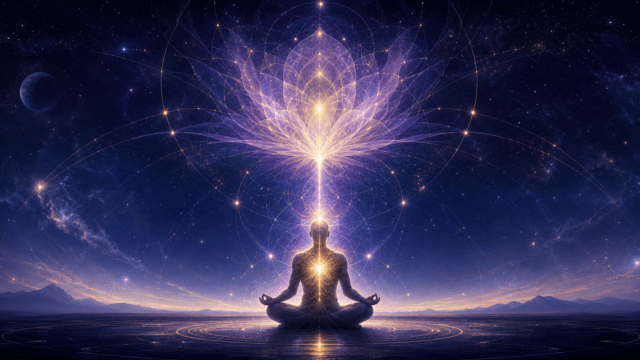
Astral Projection
Article
Classification: Metaphysical practice and reported altered state of consciousness
Related subjects: Out of body experiences, astral plane, lucid dreaming, sleep paralysis, consciousness, remote viewing, higher dimensions, and extraterrestrial contact
Overview
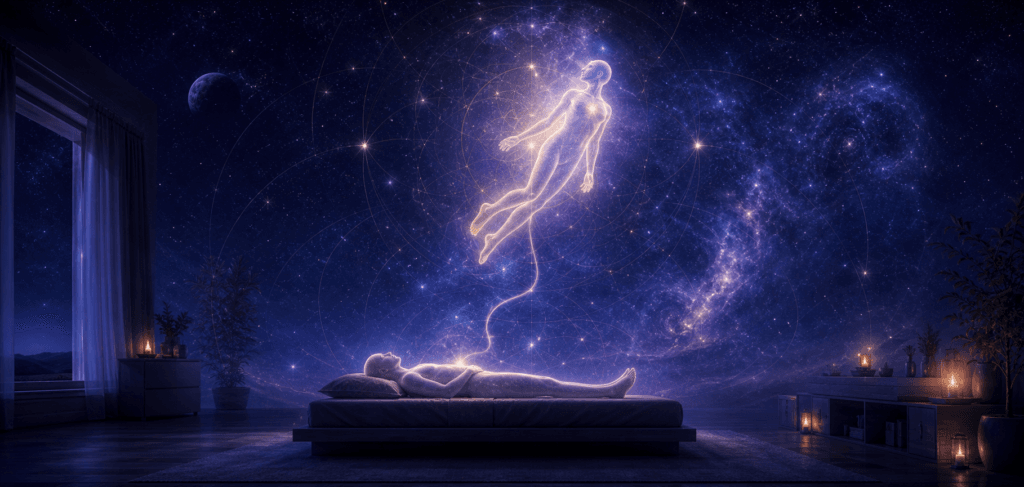
Astral projection is the claimed experience of consciousness or a spiritual body leaving the physical body and traveling independently.
Practitioners often describe the traveling form as the astral body. It may also be called the subtle body, energy body, spirit body, or double.
The astral body is believed to remain connected to the physical body while traveling through physical locations, spiritual realms, alternate dimensions, or distant parts of the universe.
Astral projection is closely related to the out of body experience. During an out of body experience, a person feels located outside the physical body and may perceive the body from an external viewpoint.
Scientific research recognizes out of body experiences as genuine subjective experiences. It does not confirm that consciousness or a spiritual body literally leaves the physical body.
Astral Projection and Out of Body Experiences
The terms astral projection and out of body experience are often used interchangeably, but they can refer to different interpretations.
An out of body experience describes what a person experiences. Astral projection provides a metaphysical explanation for that experience.
An out of body experience may happen spontaneously during sleep, illness, trauma, meditation, anesthesia, or a near-death experience.
Astral projection is more often described as intentional. The practitioner attempts to separate awareness from the body through meditation, visualization, relaxation, or other techniques.
A scientific review available through PubMed describes three common characteristics of out of body experiences:
- A sense of being located outside the physical body
- A viewpoint that appears elevated or separate from the body
- The perception of one’s own body from that external position
Historical Background
Ideas about the soul or spirit leaving the body appear in many religious and cultural traditions.
Ancient accounts describe dreams, visions, journeys to the world of the dead, communication with spirits, and travel through heavenly realms.
These traditions do not all describe the same practice. Modern astral projection combines ideas from several different religious, occult, and metaphysical systems.
Ancient Egypt
Modern occult writers sometimes associate astral projection with ancient Egyptian ideas about different elements of the person.
Egyptian religion included complex beliefs about spiritual identity and existence after death. These concepts should not automatically be treated as identical to modern astral projection.
Greek Philosophy
Some ancient Greek philosophers distinguished the soul from the body and considered whether it could exist independently.
Plato described the soul as capable of existing apart from the physical body. Later Platonist and Neoplatonist traditions developed more elaborate accounts of spiritual ascent and nonphysical reality.
Hindu and Yogic Traditions
Some Hindu and yogic traditions describe subtle bodies, channels of spiritual energy, and levels of existence beyond ordinary perception.
Modern astral projection teachings have borrowed selected terms and concepts from these traditions. The resulting practices may differ considerably from their original religious contexts.
Buddhist Traditions
Buddhist texts and traditions include accounts of dreams, visions, meditative states, and unusual abilities.
Buddhism generally does not teach an eternal, unchanging soul. Therefore, Buddhist descriptions of consciousness or subtle experience should not automatically be interpreted through Western ideas about an immortal astral body.
Western Esotericism
Modern ideas about the astral plane developed strongly within Western esotericism, Spiritualism, occultism, and Theosophy.
Theosophical teachings described several subtle bodies and planes of existence. These ideas influenced later New Age spirituality and modern literature about astral travel.
The Astral Body
The astral body is believed to be a nonphysical counterpart of the physical body.
Descriptions vary, but it may be portrayed as:
- A luminous duplicate of the physical body
- A form composed of subtle energy
- A vehicle for consciousness
- A temporary body used in spiritual realms
- An expression of the soul
- A form shaped by thought
- A bridge between physical and spiritual existence
Some practitioners report seeing the astral body as translucent, radiant, or surrounded by colored light.
There is no scientific evidence confirming the existence of an independently traveling astral body.
The Silver Cord
The silver cord is a proposed energetic connection between the astral body and the physical body.
It is often described as a luminous thread extending from the physical body to the traveling consciousness. According to some beliefs, the cord permits the astral body to return.
Stories sometimes claim that death occurs if the cord is broken. Other practitioners consider this symbolic rather than literal.
No physical or measurable silver cord has been documented.
Fear that the cord could break may produce unnecessary anxiety. Ordinary sleep, dreams, meditation, and out of body sensations do not demonstrate that a person is in danger of permanent separation from the body.
The Astral Plane
The astral plane is a proposed nonphysical realm accessible through astral projection, dreams, meditation, or death.
Descriptions may include:
- Landscapes resembling the physical world
- Symbolic environments
- Cities or temples
- Regions shaped by thought
- Areas of light or darkness
- Spirits of deceased people
- Spiritual guides
- Nonhuman entities
- Extraterrestrial beings
- Higher dimensional civilizations
Some systems divide the astral plane into lower, middle, and higher regions. Lower regions may be associated with fear or confusion, while higher regions may be associated with knowledge and spiritual beings.
These descriptions come from spiritual teachings and personal reports. No map of the astral plane has been independently verified.
Reported Stages of Astral Projection
Practitioners often describe several stages during an attempted projection.
Relaxation
The individual allows the body to become deeply relaxed while attempting to keep the mind alert.
Breathing exercises, meditation, or progressive muscle relaxation may be used.
Transitional Imagery
As the person approaches sleep, images, sounds, voices, or bodily sensations may appear.
These experiences are known as hypnagogic phenomena when they occur while falling asleep.
Vibrational Sensations
Some people report buzzing, humming, tingling, pressure, or waves of energy.
These sensations may be interpreted as activation of the astral body. They may also occur during the transition between waking and sleep.
Separation
The person may feel as though they are floating, rolling, rising, or being pulled from the body.
Common descriptions include passing through the ceiling or viewing the room from above.
Travel
The individual may report moving through familiar locations, unusual landscapes, spiritual realms, or outer space.
Return
The experience often ends suddenly. The person may feel pulled back into the body, wake abruptly, or experience a sensation of falling.
Common Induction Methods
People attempting astral projection use a variety of techniques.
Common methods include:
- Meditation
- Breath awareness
- Visualization
- Repeating an intention
- Imagining a rope above the body
- Imagining movement without physically moving
- Maintaining awareness while falling asleep
- Waking and returning to sleep
- Listening to repetitive sounds
- Focusing on bodily vibrations
- Lucid dreaming practices
These techniques may increase relaxation, dream awareness, body imagery, or unusual sleep experiences. Successful induction does not prove that consciousness has physically left the body.
Sleep Paralysis
Sleep paralysis occurs when a person becomes aware while the temporary muscle paralysis of rapid eye movement sleep continues.
During an episode, the individual may be unable to move or speak. They may also experience pressure, fear, a sensed presence, visual imagery, sounds, or a feeling of floating.
The Sleep Foundation explains that sleep paralysis can include sensations of movement, flying, and being outside the body.
Sleep paralysis can therefore be interpreted as the beginning of astral projection, an encounter with a spirit, or an extraterrestrial visitation.
From a sleep science perspective, the experience occurs when features of dreaming and wakefulness overlap.
Lucid Dreaming
A lucid dream is a dream in which the dreamer realizes that they are dreaming.
The dreamer may be able to influence the environment, move through unusual locations, or deliberately seek particular experiences.
Astral projection and lucid dreaming can feel similar. Both may include flying, passing through walls, meeting beings, or visiting unfamiliar worlds.
Practitioners often distinguish them by claiming that lucid dreams occur within the mind while astral projection takes place in an external realm.
No reliable test has established that astral projection occurs outside the dreaming mind.
False Awakening
A false awakening is a dream in which a person believes they have awakened.
The dream environment may closely resemble the actual bedroom. The person may get out of bed, move through the house, or begin an ordinary routine before realizing that they are still dreaming.
False awakenings can contribute to reports of leaving the body or moving through a physical location while asleep.
Autoscopy
Autoscopy is the experience of seeing a duplicate of one’s own body.
It can occur in neurological conditions, migraines, seizures, sleep states, and other altered experiences.
During some forms of autoscopy, the person feels located within the physical body while seeing a duplicate elsewhere. During an out of body experience, the person feels located outside the physical body and may see the physical body from that position.
These distinctions help researchers study how the brain creates bodily self-awareness.
Neurological Explanations
The brain combines visual, tactile, vestibular, and positional information to create a stable sense of being located within the body.
Disruption in this integration may produce the feeling that the self has moved elsewhere.
Research has associated out of body experiences with activity involving the temporoparietal junction, a region involved in combining sensory information and representing the body in space.
An article available through the National Library of Medicine describes neurological evidence connecting out of body experiences with multisensory processing and bodily self-awareness.
A functional brain imaging case study also examined brain activity in a participant who reported voluntarily producing sensations of being outside her body.
Such findings do not imply that the experience is imaginary or meaningless. They show that changes in bodily perception can be studied through brain activity.
Psychological Explanations
Psychological factors may also influence astral experiences.
Possible factors include:
- Expectation
- Imagination
- Absorption
- Suggestion
- Memory reconstruction
- Dissociation
- Trauma
- Anxiety
- Cultural beliefs
- Dream imagery
- Pattern recognition
A person familiar with astral projection may interpret floating sensations as separation from the body. Someone from another cultural background might interpret the same sensations as a dream, spirit encounter, or medical event.
Near-Death Experiences
Out of body sensations are frequently reported as part of near-death experiences.
A person may describe viewing medical activity from above, traveling through darkness, encountering light, or entering another realm.
Metaphysical interpretations view these reports as evidence that consciousness can exist outside the body.
Scientific explanations examine brain activity, oxygen changes, neurotransmitters, stress, memory, sleep mechanisms, and altered perception.
A 2025 neuroscience review indexed by PubMed proposed that several interacting psychological and neurophysiological processes may contribute to near-death experiences.
Research has not established that consciousness permanently separates from the brain during these events.
Astral Projection and Remote Viewing
Remote viewing is the claimed ability to obtain information about a distant or hidden target without using the ordinary senses.
Astral projection generally includes the sensation of traveling outside the body. Remote viewing may involve mental impressions without a feeling of leaving the body.
Practitioners sometimes combine the two concepts by claiming that the astral body can visit a location and observe it.
Reliable evidence would require accurate information obtained under controlled conditions without sensory access or prior knowledge. Personal impressions and occasional coincidences are not sufficient to establish the ability.
Astral Time and Distance
Practitioners sometimes report that time and distance function differently in the astral plane.
A long experience may appear to occur during a short period of sleep. Distant locations may be reached instantly through intention.
Dreams can also compress time, alter space, and shift scenes without continuous travel. These similarities make it difficult to distinguish an alleged astral journey from a vivid dream using personal experience alone.
Astral Entities
Reported astral entities include deceased people, guides, angels, animals, shadow figures, thought forms, and extraterrestrial beings.
Some encounters feel comforting, while others feel threatening.
Fear, expectation, cultural imagery, and dream processes can shape the appearance and behavior of perceived beings.
There is no confirmed method for identifying an astral entity or establishing that it exists independently of the experiencer.
Astral Projection and Extraterrestrial Contact
Some individuals report encountering extraterrestrial beings during astral projection.
These experiences may include:
- Traveling to another planet
- Entering a spacecraft
- Meeting a nonhuman intelligence
- Receiving telepathic information
- Visiting a cosmic council
- Observing an extraterrestrial civilization
- Remembering a supposed previous life on another world
- Receiving a spiritual mission
The beings may be described as biological, energetic, spiritual, or interdimensional.
Such reports do not demonstrate that the person physically traveled to another planet or communicated with an extraterrestrial intelligence.
Starseed Experiences
People who identify as starseeds may use astral projection to explore a supposed connection with another star system.
A person may report traveling to the Pleiades, Sirius, Arcturus, Andromeda, Orion, or another cosmic location.
The experience may strengthen a belief that the individual’s soul originated elsewhere.
Astral experiences can provide powerful personal meaning. They do not establish an extraterrestrial origin for a human soul.
Interdimensional Travel
Some metaphysical traditions describe astral projection as movement through higher dimensions.
Under this interpretation, the astral body is not limited by ordinary physical space. It can supposedly pass through solid matter, move instantly, and enter realities inaccessible to the physical body.
Physical theories involving extra dimensions do not provide evidence for astral travel. Scientific dimensions and spiritual planes are different concepts unless evidence demonstrates a connection.
Alleged Verification
Some practitioners claim to have verified astral projection by observing distant events or hidden objects.
Controlled verification is difficult because reports may be influenced by prior knowledge, ordinary sensory information, chance, unclear judging, and memory after the event.
Strong evidence would require:
- A target selected under controlled conditions
- No ordinary access to the target
- A description recorded before feedback
- Clear standards for judging accuracy
- Independent replication
- Results consistently better than chance
Astral projection has not met the level of evidence required for broad scientific acceptance as literal travel outside the body.
Risks and Safety
Astral projection practices are usually attempted during relaxation or sleep. However, they can produce distress for some individuals.
Possible concerns include:
- Sleep disruption
- Anxiety
- Fear of being unable to return
- Repeated sleep paralysis
- Confusion between dreams and waking events
- Dissociation
- Obsessive practice
- Avoidance of daily responsibilities
- Intensification of unusual beliefs
People should stop or reduce the practice if it causes fear, exhaustion, or difficulty functioning.
Persistent hallucinations, severe confusion, lost time, or feelings of detachment from the body during waking life should be discussed with a qualified health professional.
Responsible Interpretation
Astral projection can be studied as a spiritual practice, cultural belief, or altered state of consciousness.
A responsible approach distinguishes among:
- The subjective reality of the experience
- The personal meaning assigned to it
- The proposed spiritual explanation
- The available scientific evidence
A person can have a vivid and transformative experience without its literal interpretation being confirmed.
Extraordinary claims about distant observation, extraterrestrial travel, or communication with nonphysical entities require independent evidence.
Cultural Significance
Astral projection appears in occult literature, spiritual movements, paranormal research, film, television, games, and extraterrestrial mythology.
The idea expresses a deep human desire to overcome the limitations of the body and explore realities beyond ordinary perception.
Within extraterrestrial spirituality, astral projection offers an imagined form of cosmic travel that does not require spacecraft. It allows practitioners to interpret consciousness itself as a vehicle capable of crossing distance, worlds, and dimensions.
Whether understood as spiritual travel, lucid dreaming, neurological experience, or symbolic journey, astral projection remains an influential part of modern metaphysical culture.
See Also
- Altered States of Consciousness
- Astral Body
- Astral Plane
- Consciousness
- Dreams
- Higher Dimensions
- Lucid Dreaming
- Near-Death Experiences
- Remote Viewing
- Sleep Paralysis
- Spiritual Awakening
- Starseeds
- Telepathy
- The Soul
Sources and Further Reading
- PubMed: The Out of Body Experience, Precipitating Factors and Neural Correlates
- PubMed: Out of Body Experiences, Scoping Review
- National Library of Medicine: Out of Body Experiences and Their Neural Basis
- Frontiers in Human Neuroscience: Voluntary Out of Body Experience
- Frontiers in Human Neuroscience: The Vestibular Component in Out of Body Experiences
- Sleep Foundation: Sleep Paralysis
- PubMed: A Neuroscientific Model of Near-Death Experiences
Copyright © 2026 Mystera Headquarters. All rights reserved.