Serpent Mound
Section
Listing Name: Serpent Mound
Alternative Names: Great Serpent Mound, Serpent Mound State Memorial
Category: Sacred Indigenous Landscape, Ancient Earthwork, Archaeological Site, Astronomical Mystery, National Historic Landmark
Cultural Tradition: Ancient American Indian cultures of Ohio, with continuing importance to living Indigenous peoples
Mystery Level: High Sacred Mystery
Country: United States
State: Ohio
County: Adams County
Nearest Community: Peebles
Address:
3850 State Route 73
Peebles, OH 45660
United States
Latitude: 39.024236
Longitude: -83.429636
Short Description
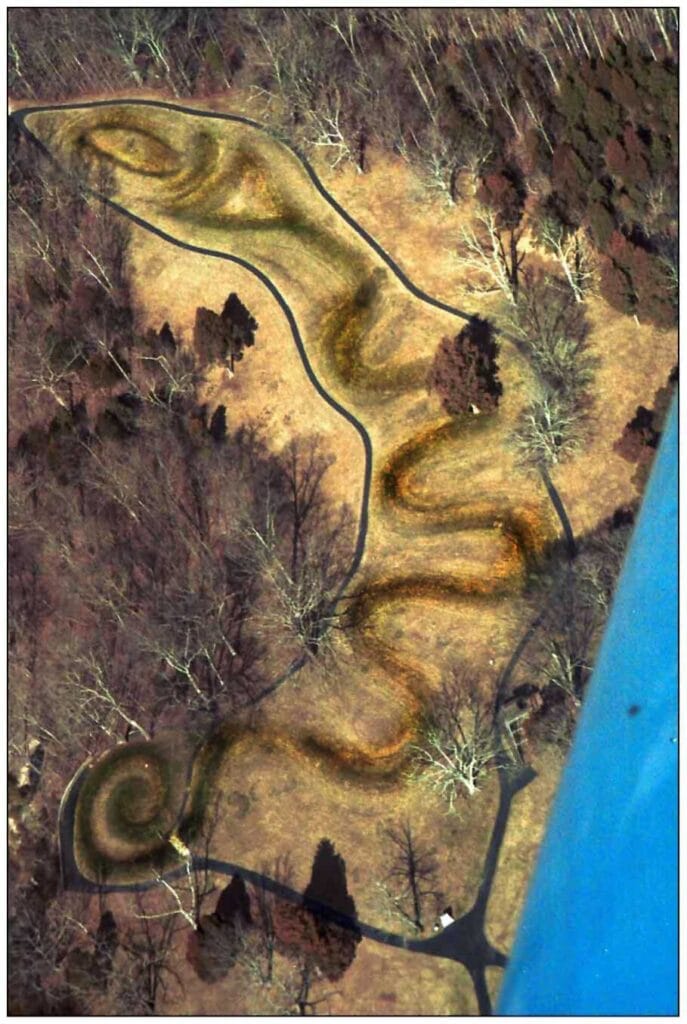
Serpent Mound is a massive earthwork shaped like a serpent with a tightly coiled tail and an open mouth facing an oval feature.
Extending more than 1,200 feet across a plateau in southern Ohio, it is the largest documented surviving ancient serpent effigy mound in the world.
Its builders, exact age, original purpose, and symbolic meaning remain subjects of investigation and debate.
The earthwork’s possible astronomical alignments, mysterious oval feature, nearby burial mounds, and location within an ancient impact structure have made it one of North America’s most remarkable sacred landscapes.
Sacred Significance
Serpent Mound was created by Indigenous people as part of a cultural landscape that held ceremonial, spiritual, and possibly astronomical importance.
The earthwork may express ideas involving the sky, changing seasons, creation, death, renewal, or the spiritual significance of serpents.
Its original meaning was not recorded in a surviving written explanation, so modern interpretations remain uncertain.
Serpents appear in the traditions of many Indigenous cultures, but beliefs differ between nations and communities. The earthwork cannot be assigned a single universal meaning based on unrelated serpent traditions.
Serpent Mound is not simply an archaeological object. It forms part of the cultural heritage of living Indigenous peoples and should be treated as a sacred and irreplaceable place.
History
Native peoples constructed thousands of mounds and ceremonial earthworks throughout what is now Ohio.
These structures included burial mounds, geometric enclosures, gathering places, and large effigies representing animals or spiritual beings.
Serpent Mound attracted scholarly attention during the nineteenth century. Archaeologist Frederic Ward Putnam conducted excavations at the site but found no artifacts inside the serpent effigy that could conclusively identify its builders.
For many years, researchers attributed the effigy to the Adena culture, which flourished in the region from approximately 800 B.C. to A.D. 100.
This conclusion was influenced partly by the presence of two nearby Adena burial mounds.
A 1991 excavation produced radiocarbon dates suggesting that the serpent was approximately 900 years old. Those results connected its construction to the Fort Ancient culture, which existed from approximately A.D. 1000 to 1650.
Research presented in 2014 produced different radiocarbon dates suggesting that the earthwork may have been created by the Adena culture around 300 B.C.
The conflicting results mean that the age and cultural identity of the builders have not been conclusively settled.
Three burial mounds are located near the serpent effigy. Two are associated with the Adena culture, while one is associated with the Fort Ancient culture.
Serpent Mound became a National Historic Landmark in 1964. It was later added to the National Register of Historic Places and remains under the management of the Ohio History Connection.
Shape and Construction
The earthwork depicts a serpent with a coiled tail, a winding body, and an open mouth positioned near an oval formation.
The oval has been interpreted in several ways. It may represent an egg, an eye, the sun, the head of another creature, or a separate ceremonial feature.
No interpretation has been conclusively established.
The serpent was constructed from earth and stone placed across the surface of a narrow plateau.
Unlike the nearby burial mounds, the serpent itself is not generally understood to contain human remains.
The monument’s full design is difficult to appreciate from ground level. An observation tower allows visitors to view more of the serpent’s shape from above.
Astronomical Alignments
The serpent’s head points toward the location of the sunset near the summer solstice.
Other curves in the earthwork have been interpreted as possible alignments with seasonal sunrises, sunsets, or lunar events.
The summer solstice alignment is the best known astronomical feature associated with the site. It suggests that the builders may have connected the monument with the movement of the sun and the changing seasons.
Researchers continue to debate whether every proposed alignment was intentional.
Because the original builders left no surviving written explanation, the complete astronomical purpose of the earthwork remains unknown.
The Serpent Mound Impact Structure
Serpent Mound stands near the center of a large geological disturbance created by an ancient meteorite or comet impact.
The impact occurred hundreds of millions of years before humans constructed the earthwork.
The ancient impact altered and uplifted the surrounding rock. Erosion later helped produce the unusual elevated landscape on which the serpent was built.
There is no evidence that the builders knew the distant geological origin of the land.
However, the prominent plateau and surrounding terrain may have influenced their decision to construct the effigy at this location.
The geological impact structure and the human built serpent are separate events divided by hundreds of millions of years.
Legends and Unusual Experiences
Visitors sometimes report feeling a powerful sense of peace, heightened awareness, unusual energy, or a strong connection to the surrounding landscape.
Modern spiritual groups have described the location as an energy center or vortex.
Other stories involve unexplained lights, unusual compass behavior, vivid dreams, emotional reactions, or a feeling of being watched.
These claims have not been consistently documented or scientifically verified.
Compasses and electronic equipment may be affected by ordinary mechanical problems, batteries, nearby objects, environmental conditions, or user expectations.
The site’s established mysteries are already substantial. Researchers continue to study who constructed the serpent, when it was built, what the oval represents, and whether all of its proposed astronomical alignments were intentional.
Personal spiritual experiences should be distinguished from established archaeological and historical evidence.
Reported Paranormal Activity
Serpent Mound does not have a well documented haunted reputation.
Its mystery comes from its ancient construction, uncertain purpose, sacred character, astronomical features, and reported spiritual atmosphere rather than from established ghost stories.
Some visitors describe unexplained sensations, feelings of being watched, unusual silence, changes in mood, or electronic equipment behaving unpredictably while walking near the earthwork.
These reports are personal experiences and do not establish the presence of paranormal activity.
There is no reliable evidence of hostile entities or dangerous supernatural phenomena at the site.
A respectful investigation may document environmental conditions, personal experiences, archaeology, astronomy, and publicly available cultural history.
Investigators must remain on designated paths, avoid disturbing the earthwork and nearby burial mounds, and receive advance authorization for organized activities or specialized access.
Entry outside official operating hours is prohibited.
Why This Place Is Unique
Serpent Mound combines sacred history, monumental landscape design, astronomical possibilities, archaeological uncertainty, and an unusual geological setting.
Its mysteries do not depend on a single legend.
Researchers still disagree about its age and builders. The oval feature remains unexplained, and its complete relationship with the sky is uncertain.
The earthwork also represents an extraordinary physical achievement.
Its creators shaped more than 1,200 feet of land into a unified figure that can still be recognized centuries or possibly thousands of years later.
The site’s importance continues through its connection with living Indigenous peoples, archaeological research, education, and personal spiritual experiences.
Investigation Guidelines
Historical, archaeological, spiritual, environmental, and paranormal research must follow all Ohio History Connection rules.
An ordinary visit does not authorize a formal investigation, specialized equipment, after hours access, exclusive use, ceremonies, or entry into restricted areas.
Investigators must remain on designated paths and must never walk on, climb, sit on, or place equipment upon the serpent or nearby burial mounds.
Digging, probing, soil sampling, metal detecting, artifact collecting, ground disturbance, and removal of natural or cultural materials are prohibited.
Equipment must not block paths, interfere with other visitors, damage vegetation, or be attached to archaeological features.
Investigators should not conduct spirit provocation, imitate Indigenous ceremonies, light fires or candles, scatter substances, or leave offerings without authorization.
Audio recordings should be conducted quietly and only where permitted. Investigators must respect other visitors and any authorized ceremonies taking place at the site.
Organized groups, specialized equipment, ceremonies, commercial work, or activities extending beyond an ordinary visit require advance permission from the Ohio History Connection.
Investigation reports should distinguish between measured environmental observations, archaeological evidence, personal experiences, cultural traditions, and unverified paranormal interpretations.
Visitor Information
Serpent Mound is managed by the Ohio History Connection.
The property includes the earthwork, walking paths, an observation tower, a museum, and visitor facilities.
The museum and grounds are currently closed on Mondays.
They are normally open Tuesday through Saturday from 10:00 a.m. until 5:00 p.m. Sunday hours are normally 12:00 p.m. until 5:00 p.m.
Final entry is at 4:00 p.m., and all visitors must leave by 5:00 p.m.
Weather, holidays, maintenance, and special events may affect access.
A parking fee is charged per vehicle. Visitors should verify current prices, hours, closures, and event information through the official website before traveling.
Access is not permitted when the gates are closed. Monday, holiday, and after hours entry is prohibited.
Pets are permitted but must remain leashed.
Respect and Cultural Restrictions
Visitors must remain on designated paths and must never walk on, climb, sit on, or damage any part of the serpent or nearby burial mounds.
Digging, metal detecting, artifact collecting, leaving objects on the earthwork, removing soil, and disturbing archaeological materials are prohibited.
The nearby burial mounds require particular respect. Visitors should behave as they would in any cemetery or sacred memorial.
Unauthorized rituals, fires, candles, offerings, scattering substances, and large gatherings may damage the site or interfere with other visitors.
Any organized ceremony, gathering, or investigation should receive advance approval from site management.
Serpent Mound belongs to the cultural heritage of Indigenous peoples. Its spiritual importance and archaeological value should not be reduced to entertainment or used to support unsupported conspiracy claims.
Photography Restrictions
Personal exterior photography is generally compatible with an ordinary visit when it does not interfere with other visitors or violate posted restrictions.
Drones are prohibited at all Ohio History Connection sites.
Commercial photography and filming require advance authorization from the Ohio History Connection.
Visitors should check current rules before bringing professional cameras, tripods, lighting equipment, recording stations, or other production equipment.
Photography and recording must not be used as reasons to climb the earthwork, enter restricted areas, disturb burial mounds, leave designated paths, or interfere with ceremonies.
Accessibility
The visitor experience includes outdoor paths, grass, changes in elevation, and an observation tower.
Access to individual features may vary according to mobility needs, weather, and ground conditions.
Visitors who need step free access or other accommodations should contact the site before traveling.
The observation tower may not be accessible to all visitors.
Official Website
Ohio History Connection: Serpent Mound
Mystera Classification
Sacred: Yes
Active Place of Worship: Not in the conventional institutional sense, although the landscape remains spiritually important
Indigenous Cultural Site: Yes
Archaeologically Unique: Yes
Astronomically Significant: Possibly, with a recognized summer solstice alignment
Associated With Burials: Yes, through nearby burial mounds
Haunted: Not established
Reported Spiritual Experiences: Yes
Reported Paranormal Experiences: Anecdotal and unverified
Reported Energy or Vortex Claims: Yes, but not scientifically verified
Paranormal or Spiritual Investigation: Research may occur during official operating hours using lawful, quiet, and noninvasive methods. Organized investigations, specialized equipment, ceremonies, or access outside normal visitor activities require advance permission from the Ohio History Connection.
Publicly Accessible: Yes, during official operating hours and subject to site restrictions
Sources and Image Credit
Ohio History Connection: Serpent Mound
National Park Service: Visiting Indigenous Landscapes
National Park Service: Hopewell Ceremonial Earthworks and Serpent Mound
Photograph: “Serpent Mound, Aerial View” by Timothy A. Price and Nichole I. The image was adjusted for brightness and contrast by Locutus Borg. Licensed under Creative Commons Attribution 2.5. View and download the original photograph and license information.
© 2026 Mystera Headquarters. All rights reserved.