Mount Shasta
Section
Listing Name: Mount Shasta
Alternative Names: Mount Shasta Volcano, Shasta
Category: Sacred Indigenous Mountain, Active Volcano, Wilderness Area, Spiritual Pilgrimage Site, UFO Landmark, Modern Mystery Site
Cultural Traditions: Wintu, Shasta, Pit River, and other Indigenous peoples of Northern California
Mystery Level: High Sacred and Paranormal Mystery
Country: United States
State: California
County: Siskiyou County
Nearest City: Mount Shasta
Visitor and Permit Information Address:
Mount Shasta Ranger Station
204 West Alma Street
Mount Shasta, CA 96067
United States
Latitude: 41.409000
Longitude: -122.193000
Elevation: Approximately 14,163 feet
Short Description
Mount Shasta is a massive, glacier covered stratovolcano rising above the forests and valleys of Northern California.
It is the most voluminous volcano in the Cascade Range and is classified by the United States Geological Survey as having a very high volcanic threat potential.
The mountain has been sacred to Indigenous peoples for generations. It later became a destination for spiritual seekers, occult groups, UFO researchers, climbers, and people interested in unusual phenomena.
Modern legends describe a hidden city inside the mountain, surviving people from the lost continent of Lemuria, spiritual energy vortexes, mysterious lights, unidentified aerial objects, unusual beings, and powerful personal transformations.
These modern stories must remain separate from the older and continuing sacred traditions of the Indigenous peoples connected with Mount Shasta.
Sacred Significance
Mount Shasta forms part of the ancestral homelands and sacred landscapes of several Indigenous peoples, including Wintu, Shasta, and Pit River communities.
Different communities maintain distinct names, histories, ceremonies, and relationships with the mountain.
Springs, meadows, caves, peaks, plants, water sources, and other landscape features may hold spiritual or ceremonial importance.
Some sacred locations and traditions are private. Public access to a natural area does not grant permission to enter ceremonies, photograph sacred objects, collect plants, imitate religious practices, or demand private cultural information.
The mountain is also sacred to many modern spiritual visitors. People travel to Mount Shasta for meditation, prayer, healing, personal reflection, retreats, and ceremonies.
Modern spiritual practices should not be presented as ancient Indigenous traditions unless a reliable tribal source confirms the connection.
Indigenous Cultural Connections
Indigenous peoples lived in the Mount Shasta region long before the arrival of European explorers and settlers.
The mountain, rivers, springs, forests, animals, and surrounding landscape formed part of cultural life, ceremony, food gathering, travel, healing, and spiritual understanding.
Mount Shasta appears in traditional narratives involving creation, powerful beings, the structure of the world, and relationships between humans and the land.
These traditions differ between communities. A story belonging to one nation should not be attributed to every Indigenous group in the region.
Some Indigenous people regard recreational climbing, careless tourism, unauthorized ceremonies, and damage to sensitive areas as disrespectful to the mountain.
Visitors and investigators should seek information directly from tribal cultural sources whenever possible and respect knowledge that communities choose to keep private.
Geological History
Mount Shasta is a compound stratovolcano made primarily of andesite and dacite.
It began forming on the remains of an older volcano that partly collapsed approximately 300,000 to 500,000 years ago.
That collapse produced one of the largest known landslides on Earth. Debris spread across approximately 170 square miles of Shasta Valley.
The modern mountain includes several overlapping volcanic features, including the main Hotlum Cone and the Shastina cone on its western side.
The youngest dated eruption occurred approximately 3,200 years ago. Hot springs and volcanic gases near the summit show that the system remains hot.
The United States Geological Survey continuously monitors earthquakes, ground movement, gas, and other signs of volcanic activity.
Mount Shasta is not currently erupting. Any future eruption would probably be preceded by increased earthquakes, ground deformation, gas release, or other warning signs.
The mountain also produces nonvolcanic hazards. Rockfall, avalanches, glacial movement, severe storms, sudden temperature changes, altitude illness, and mudflows can endanger visitors.
Lenticular Clouds
Mount Shasta is famous for dramatic lenticular clouds that form near its summit.
These clouds develop when moist air flows over the mountain, cools, condenses, and forms smooth lens shaped layers.
They may appear stationary even when strong winds are moving through them. Multiple layers can create formations resembling stacked discs or enormous spacecraft.
Lenticular clouds have contributed to UFO stories because they often resemble the popular image of a flying saucer.
The United States Geological Survey explains that most unusual clouds near the summit result from ordinary atmospheric conditions rather than volcanic activity or hidden aircraft.
The Mount Shasta Sisson Museum notes a local legend claiming that large lenticular clouds conceal a Lemurian mothership.
This is modern folklore rather than scientific evidence.
The Lemurian Legend
One of Mount Shasta’s most famous modern legends concerns Lemuria, a supposed lost continent in the Pacific Ocean.
Occult writers claimed that survivors of Lemuria escaped destruction and created an advanced underground city inside Mount Shasta.
The hidden city is often called Telos. Its inhabitants are described as tall, spiritually advanced beings who wear white robes and possess unusual knowledge or technology.
Stories claim that Lemurians occasionally appear on the mountain, visit nearby communities, create mysterious lights, or communicate telepathically with spiritually receptive people.
The Mount Shasta Lemurian legend developed through modern occult literature rather than Indigenous tradition.
Frederick Spencer Oliver’s 1894 book “A Dweller on Two Planets” connected Mount Shasta with an underground mystical civilization.
Later writings, including a 1931 book by Harvey Spencer Lewis, helped popularize the belief in hidden Lemurians beneath the mountain.
No verified archaeological, geological, or physical evidence of Telos or a Lemurian civilization has been discovered inside Mount Shasta.
The legend remains an important part of the region’s modern spiritual and paranormal identity.
UFO and Aerial Phenomena
Mount Shasta has a long modern reputation for unidentified lights and unusual objects in the sky.
Witnesses report glowing orbs, moving lights, triangular objects, disc shaped formations, and lights that appear to enter or leave the mountain.
Some observations may involve aircraft, satellites, meteors, planets, atmospheric reflections, drones, or lenticular clouds.
The mountain’s dark skies, high elevation, changing weather, and limited reference points can make distance, size, and movement difficult to judge.
UFO researchers sometimes describe Mount Shasta as an extraterrestrial base or portal. These claims have not been established through reliable physical evidence.
Investigators should record the date, time, direction, duration, weather, aircraft activity, satellite paths, camera settings, and witness locations when documenting an unusual aerial event.
Energy Vortex Claims
Many spiritual visitors describe Mount Shasta as an energy vortex, planetary chakra, dimensional gateway, or center of spiritual transformation.
Reported experiences include tingling sensations, pressure changes, emotional release, vivid dreams, visions, unusual coincidences, altered awareness, and a feeling of connection with the mountain.
Some visitors identify particular springs, meadows, rocks, and trails as powerful energy locations.
No scientific instrument has consistently demonstrated a unique spiritual energy field at Mount Shasta.
Altitude, exertion, dehydration, temperature, expectation, meditation, natural beauty, silence, and strong emotion may contribute to unusual sensations.
Personal spiritual experiences can be meaningful without being presented as scientifically verified physical forces.
Legends of Hidden Beings
In addition to Lemurians, Mount Shasta folklore includes stories of Bigfoot, mysterious robed figures, invisible guardians, spirit beings, and people who appear or disappear unexpectedly.
Some hikers report hearing footsteps without seeing another person, noticing unusual tracks, or feeling followed in remote forest areas.
Wildlife, other hikers, changing visibility, snow movement, falling rocks, wind, and unfamiliar tracks can create mysterious experiences.
The forests surrounding Mount Shasta lie within a broader region strongly associated with Bigfoot traditions and modern sightings.
No body, verified biological sample, or other conclusive scientific evidence has established the existence of an unknown large primate at Mount Shasta.
Reported Paranormal Activity
Mount Shasta has a stronger paranormal reputation than many sacred natural sites.
Reported experiences include unexplained lights, UFO sightings, vivid dreams, apparitions, voices, invisible presences, missing time, electronic disturbances, unusual photographs, and encounters with mysterious beings.
Some visitors report that batteries drain quickly, compasses behave unpredictably, cameras malfunction, or electronic equipment produces unexplained readings.
Cold temperatures, battery condition, moisture, altitude, magnetic objects, software problems, poor reception, and user error must be considered before an equipment event is classified as unexplained.
The mountain’s size and wilderness conditions make controlled investigation difficult. Locations, weather, altitude, and environmental variables can change rapidly.
No reported paranormal phenomenon at Mount Shasta has been conclusively verified through repeatable scientific testing.
Why This Place Is Unique
Mount Shasta combines living Indigenous sacred traditions, an active volcanic system, wilderness, spiritual pilgrimage, occult history, UFO culture, and modern paranormal investigation.
Its physical appearance contributes to its mystery. The mountain rises dramatically above the surrounding landscape and frequently produces unusual cloud formations.
Unlike a building or contained archaeological site, Mount Shasta is an enormous living landscape. Different areas may have distinct environmental, cultural, and spiritual importance.
The mountain’s unusual reputation includes both deeply rooted Indigenous connections and much newer stories involving Lemuria, extraterrestrials, hidden cities, energy vortexes, and unexplained beings.
These traditions should be identified according to their actual origins rather than blended together.
Investigation Guidelines
Historical, spiritual, environmental, UFO, and paranormal investigations must follow all Forest Service rules and wilderness regulations.
Investigators should begin by identifying whether the intended location is public land, private property, tribal land, a protected ecological area, or a culturally restricted site.
An ordinary wilderness permit does not authorize a formal event, commercial production, exclusive access, collection of materials, entry into closed areas, or disturbance of ceremonies.
Investigators must not enter caves, mines, private roads, restricted meadows, ceremonial areas, or unstable volcanic terrain without lawful access and appropriate authorization.
Equipment should remain handheld or be placed only on durable surfaces where it cannot damage plants, soil, water, wildlife, or cultural materials.
Investigators should not attach objects to trees, rocks, signs, or natural features.
Water, rocks, plants, soil, archaeological objects, prayer items, and ceremonial materials must not be removed.
Private ceremonies must not be approached, photographed, recorded, or interrupted.
Investigators must not imitate Indigenous ceremonies or identify modern rituals as tribal practices without confirmation.
Environmental observations should include weather, altitude, temperature, wind, cloud formations, aircraft, satellites, wildlife, magnetic objects, battery condition, and camera settings.
Night investigations require careful planning, lawful parking, navigation equipment, emergency supplies, and awareness of weather, wildlife, terrain, and wildfire restrictions.
Reports should distinguish Indigenous traditions, modern occult folklore, witness testimony, personal spiritual experiences, environmental observations, and unverified paranormal interpretations.
Climbing and Wilderness Permits
Climbing Mount Shasta is a serious mountaineering activity rather than an ordinary hike.
A wilderness permit is required for travel within the Mount Shasta Wilderness.
A Summit Pass is required for travel above 10,000 feet. Fees and permit procedures may change.
Visitors should obtain current information from the Mount Shasta Ranger Station or Mount Shasta Avalanche Center before beginning a climb.
Snow, ice, rockfall, avalanches, whiteout conditions, altitude illness, and sudden storms can become life threatening.
Climbers should have appropriate skills, clothing, navigation equipment, traction devices, helmets, emergency supplies, and knowledge of the selected route.
Guided climbing services must hold valid authorization from the Forest Service.
A spiritual or paranormal purpose does not reduce the mountain’s physical dangers.
Visitor Information
Mount Shasta is located within the Shasta Trinity National Forest and Mount Shasta Wilderness.
The mountain does not have a single entrance gate or one visitor schedule. Access depends on roads, trailheads, snow, wildfire conditions, seasonal closures, and wilderness regulations.
Bunny Flat is one of the main trailheads and climbing access points. Road access may be affected by snow and winter conditions.
Visitors should contact the Mount Shasta Ranger Station and review current avalanche, climbing, fire, and weather information before traveling into high elevation areas.
Parking passes, wilderness permits, Summit Passes, fire restrictions, and commercial use rules may apply depending on the activity and location.
Cellular service is unreliable in many areas. Visitors should carry offline maps, water, food, weather protection, emergency supplies, and a dependable navigation method.
Respect and Cultural Restrictions
Mount Shasta is a sacred landscape connected with living Indigenous peoples.
Visitors must respect ceremonies, prayer areas, sacred springs, cultural objects, and requests for privacy.
Prayer ties, offerings, bundles, and ceremonial items must not be touched, moved, opened, photographed closely, or removed.
Sensitive meadows and alpine plants are easily damaged. Visitors must remain on established routes where required and avoid trampling vegetation.
Water sources must not be contaminated with oils, crystals, ashes, herbs, soap, food, candles, or ritual substances.
Visitors should not leave crystals, statues, cloth, coins, food, ashes, or other offerings on public land without authorization.
Modern spiritual groups must not claim ownership of the mountain or present recently created beliefs as ancient Indigenous teachings.
Climbing, investigation, meditation, and photography should be conducted with awareness that others may regard the mountain itself as a living sacred being.
Photography Restrictions
Personal photography is generally permitted on public Forest Service land when it does not damage resources or interfere with other visitors.
Photography on private property, tribal land, during ceremonies, or in restricted cultural locations requires permission.
Commercial filming, organized productions, large crews, sets, exclusive use, and activities affecting resources may require Forest Service authorization.
Drones are subject to federal aviation rules, wilderness restrictions, wildfire flight restrictions, and local closures. Launching or landing a drone inside designated wilderness is prohibited.
Photography must not be used as a reason to leave trails, enter closed areas, disturb wildlife, approach ceremonies, or damage sensitive plants.
Accessibility
Accessibility varies greatly because Mount Shasta is a mountain wilderness rather than a developed historical property.
Some viewpoints, visitor facilities, roads, and lower elevation recreation areas may provide accessible options.
High elevation trails and summit routes involve steep terrain, snow, ice, loose rock, altitude, and rapidly changing weather.
Visitors with mobility, respiratory, cardiac, vision, hearing, or other accessibility concerns should contact the Forest Service for current information about suitable locations.
Official Websites
Shasta Trinity National Forest
United States Geological Survey: Mount Shasta
Mystera Classification
Sacred: Yes
Indigenous Cultural Site: Yes
Active Volcano: Yes
Geologically Unique: Yes
Associated With Modern Spiritual Pilgrimage: Yes
Associated With Lemurian Folklore: Yes
Associated With UFO Reports: Yes
Associated With Bigfoot Reports: Yes
Haunted: Not established in the conventional sense
Reported Spiritual Experiences: Yes
Reported Paranormal Experiences: Yes, but unverified
Paranormal, Spiritual, or UFO Investigation: Permitted through lawful public access using respectful, safe, and noninvasive methods. Formal events, commercial activities, restricted access, specialized land use, or entry beyond ordinary visitor activities may require authorization.
Publicly Accessible: Yes, subject to permits, weather, road conditions, closures, wilderness regulations, and private or culturally restricted areas
Sources and Image Credit
Shasta Trinity National Forest
Mount Shasta Avalanche Center: Climbing Advisory
United States Geological Survey: Mount Shasta
United States Geological Survey: Geology and Eruption History
United States Geological Survey: Mount Shasta Lenticular Clouds
Mount Shasta Sisson Museum: Lenticular Cloud Formations
Mount Shasta Sisson Museum: Tribal Research Resources
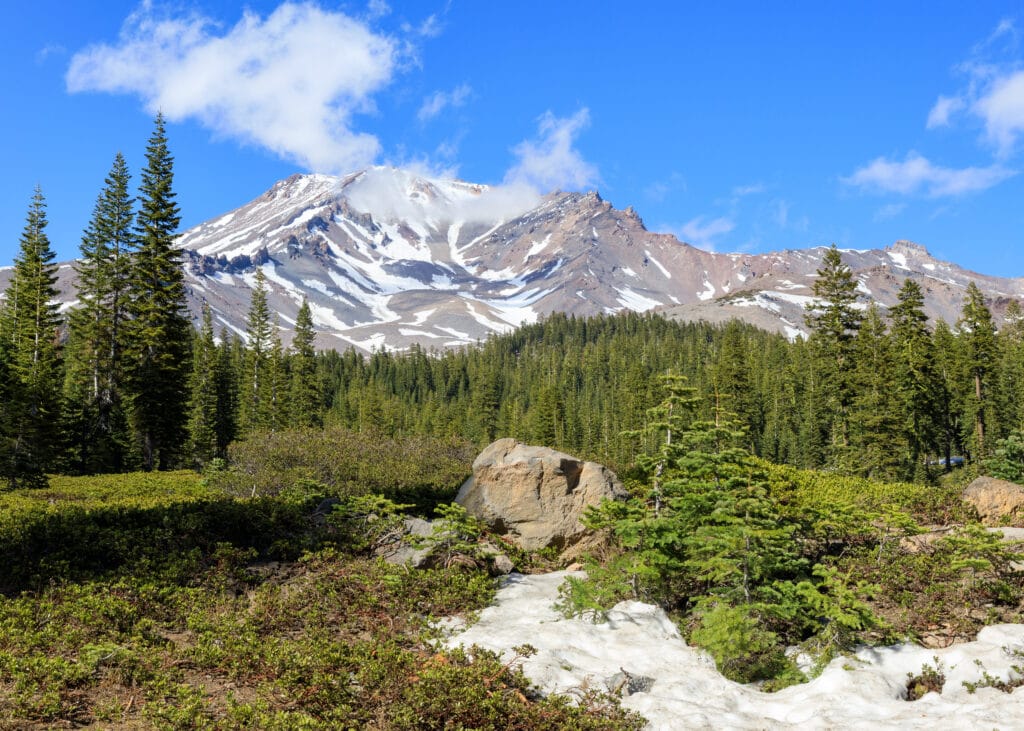
Photograph: “Mount Shasta as Seen from Bunny Flat” by Frank Schulenburg. Licensed under Creative Commons Attribution ShareAlike 4.0. View and download the original photograph and license information.
© 2026 Mystera Headquarters. All rights reserved.