Mesa Verde National Park
Section
Listing Name: Mesa Verde National Park
Alternative Name: Mesa Verde
Category: Sacred Indigenous Landscape, Ancestral Puebloan Site, Cliff Dwelling Complex, Archaeological Site, National Park, World Heritage Site
Cultural Traditions: Ancestral Puebloan, with continuing connections to 27 associated Pueblos, Tribes, and Nations
Mystery Level: High Sacred Mystery
Country: United States
State: Colorado
County: Montezuma County
Nearest Cities: Mancos and Cortez
Visitor Center Address:
34840 Highway 160
Mancos, CO 81328
United States
Latitude: 37.230900
Longitude: -108.461800
Short Description
Mesa Verde National Park protects thousands of ancestral sites created by Indigenous people who lived in the region for generations.
The park is best known for its remarkable cliff dwellings, including Cliff Palace, Balcony House, Long House, and Spruce Tree House. These carefully constructed communities contain rooms, towers, plazas, and ceremonial spaces built into natural sandstone alcoves.
Mesa Verde remains a sacred ancestral homeland connected to living Pueblo and Hopi communities. Ute, Navajo, and Apache people also maintain important relationships with the wider landscape.
Questions remain about the purposes of particular buildings, ceremonial spaces, astronomical features, migration decisions, and experiences reported by modern visitors.
Sacred Significance
Mesa Verde is a special and sacred place for 27 associated Pueblos, Tribes, and Nations.
The Pueblo and Hopi people are direct descendants of the Ancestral Pueblo people who built and lived in the communities preserved within the park.
The buildings are ancestral homes rather than the remains of a vanished people. Descendant communities continue to visit Mesa Verde to remember their ancestors, share knowledge, conduct cultural activities, and maintain connections with the landscape.
Kivas, plazas, towers, springs, mesas, and other natural and human built features may hold ceremonial or spiritual importance.
Some information about sacred traditions, place names, ceremonies, and archaeological features is private. Visitors and investigators must respect cultural knowledge that communities have chosen not to share publicly.
History
Human history at Mesa Verde extends back approximately 12,000 years.
Over time, hunting and gathering communities developed farming traditions centered on corn, beans, and squash.
People constructed early homes partly below ground. Later communities built larger villages on the mesa tops using stone, earth, timber, and plaster.
Between approximately A.D. 500 and 1300, tens of thousands of Ancestral Pueblo people lived throughout the Four Corners region.
Most of Mesa Verde’s famous cliff dwellings were constructed during the late twelfth and thirteenth centuries.
The people of Mesa Verde were skilled farmers, builders, artists, traders, and observers of the natural world. They constructed reservoirs, terraces, check dams, and other systems to manage water and support agriculture.
Pottery, woven materials, tools, murals, and imported objects reveal artistic traditions and connections with distant communities.
During the thirteenth century, families gradually moved away from the Mesa Verde region and traveled south toward communities in present day New Mexico and Arizona.
Persistent drought, limited resources, social changes, conflict, religious developments, and migration traditions may all have influenced these decisions.
The people did not disappear. They continued their cultures in new communities, and their descendants remain connected with Mesa Verde today.
Mesa Verde National Park was established in 1906. It was the first United States national park created primarily to preserve the works and history of people.
The park became a UNESCO World Heritage Site in 1978.
Cliff Palace
Cliff Palace is the largest cliff dwelling in Mesa Verde National Park and one of its most recognizable archaeological sites.
The complex contains approximately 150 rooms, numerous kivas, towers, passageways, and open spaces.
Its builders shaped sandstone blocks and joined them with mortar made from soil, water, and ash. Many walls were once covered with plaster.
Researchers continue to debate exactly how Cliff Palace was used. It may have served as a residential community, ceremonial center, gathering place, administrative location, or a combination of functions.
Entry normally requires a reserved ranger guided tour. Visitors may also view Cliff Palace from designated overlooks when roads and viewpoints are open.
Visitors may not enter the dwelling without authorization and an official tour.
Balcony House
Balcony House is a cliff dwelling that visitors can enter through a physically demanding ranger guided tour.
The route may require climbing ladders, crawling through a tunnel, and traveling along steep or exposed areas.
The community contains rooms, plazas, passageways, and kivas constructed beneath a sandstone overhang.
Its location may have offered protection from weather while also creating challenges involving water, farming, access, and movement.
Tour reservations are required, and visitors must evaluate the physical demands before participating.
Spruce Tree House
Spruce Tree House is one of the best preserved cliff dwellings in the park.
The site contains rooms, kivas, and other architectural features protected by a large natural alcove.
Direct access has been restricted because of concerns involving unstable rock above the dwelling.
Visitors may normally view Spruce Tree House from approved overlooks, but access conditions can change.
The closure demonstrates that preservation and visitor safety may require restrictions even at well known locations.
Kivas and Ceremonial Spaces
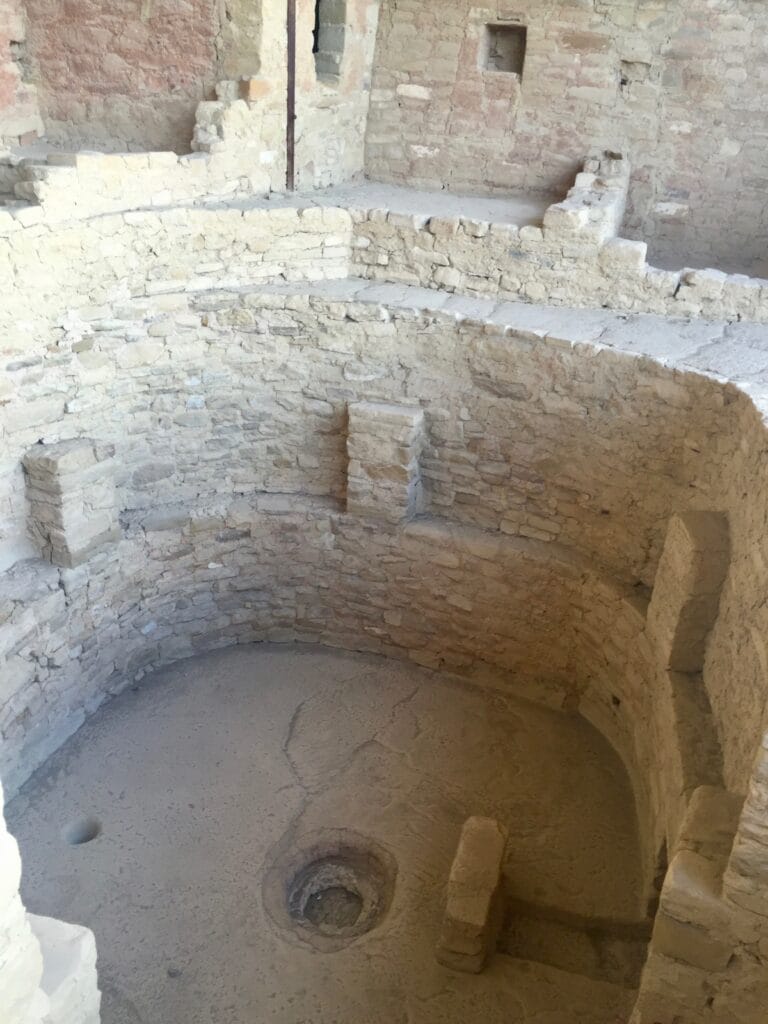
Kivas are circular or partly underground rooms associated with community activities, teaching, ceremony, and spiritual practice.
Many Mesa Verde communities contain several kivas. Larger villages may have used them for different families, clans, societies, or ceremonial purposes.
Common features include benches, ventilation systems, fire pits, and small floor openings known as sipapus.
In some Pueblo traditions, the sipapu represents a place of emergence or connection with another world. Meanings vary between communities and should not be treated as a single universal explanation.
Visitors must not enter, touch, climb into, or place equipment inside a kiva unless an authorized tour specifically permits access.
Astronomy and Sun Temple
Sun Temple is a large D shaped structure located near Cliff Palace.
Its precise purpose remains uncertain. Archaeologists generally interpret it as a ceremonial complex rather than an ordinary residence.
Research has identified possible solar and lunar relationships in its design and location.
A modern marker at the site indicates a possible winter solstice sunset alignment involving Sun Temple and another feature across the canyon.
The building appears to have been unfinished or left without some expected features. This has raised questions about whether construction stopped during a period of social change or migration.
The structure’s geometry, astronomical relationships, and unfinished state make it one of Mesa Verde’s most intriguing mysteries.
Migration and the Myth of Disappearance
Older accounts sometimes claimed that Mesa Verde’s people mysteriously vanished.
Archaeology and Indigenous oral histories show that they migrated rather than disappeared.
During the late thirteenth century, families moved toward communities along the Rio Grande, the Little Colorado River, the Hopi Mesas, and other areas.
Reasons for migration probably differed between individuals and communities. Drought, environmental pressure, family connections, conflict, changing leadership, and religious developments may all have played roles.
For Pueblo people, migration can also be understood as an important part of cultural history and a continuing journey.
Modern Pueblo and Hopi communities preserve traditions, architecture, agricultural knowledge, art, language, and oral histories connected with their Mesa Verde ancestors.
Legends and Unusual Experiences
Visitors sometimes describe Mesa Verde as peaceful, emotionally intense, unusually quiet, or spiritually powerful.
Some people report feeling a presence near cliff dwellings, kivas, overlooks, or isolated mesa top sites.
Other anecdotal accounts mention distant voices, footsteps, shadows, unexplained lights, sudden temperature changes, vivid dreams, or a sensation that a dwelling remains occupied.
These experiences have not been scientifically verified.
Wind moving through alcoves, wildlife, echoes, falling stones, changes in sunlight, weather, altitude, isolation, and strong emotional responses can create unusual sights and sounds.
Personal experiences should be documented without presenting them as proof of spirits or paranormal activity.
Reported Paranormal Activity
Mesa Verde is not primarily classified as a haunted location.
Its mysterious reputation comes from its sacred character, ancestral architecture, migration history, ceremonial spaces, isolated landscape, and reported spiritual atmosphere.
Some visitors and employees have shared stories involving voices, footsteps, shadows, lights, and feelings of being watched. These reports are anecdotal and do not establish a consistent pattern of paranormal activity.
There is no reliable evidence of hostile entities or dangerous supernatural forces at Mesa Verde.
Stories of paranormal activity must not be used to portray Ancestral Pueblo people as vanished, primitive, cursed, or trapped at the site.
A respectful investigation may document environmental conditions, architecture, astronomy, acoustics, history, personal experiences, and publicly available Indigenous perspectives.
Formal investigations, specialized recording, access to closed areas, or activities beyond an ordinary visit require advance authorization from the National Park Service.
Why This Place Is Unique
Mesa Verde protects one of the world’s most remarkable collections of ancestral Pueblo architecture.
Its cliff dwellings demonstrate sophisticated knowledge of masonry, farming, water management, landscape use, trade, and community organization.
The site is both archaeological and living. Descendant communities continue to visit Mesa Verde and maintain cultural relationships with the landscape.
Sun Temple and other structures reveal possible astronomical planning, while the cliff dwellings raise questions about community life, ceremony, defense, climate, and migration.
Mesa Verde is unique because its history can be studied through architecture, archaeology, oral tradition, environmental science, astronomy, and living Indigenous culture.
Investigation Guidelines
Historical, spiritual, environmental, and paranormal research must follow all National Park Service rules.
An ordinary visit does not authorize a formal investigation, entry into cliff dwellings, specialized equipment, after hours access, exclusive use, or access to closed archaeological areas.
Cliff dwellings may only be entered through authorized access. Most require a reserved ranger guided tour.
Investigators must not climb walls, enter closed rooms, crawl into restricted spaces, touch artifacts, collect materials, disturb soil, or place equipment on archaeological features.
Spirit provocation, attempts to summon the dead, imitation of Indigenous ceremonies, unauthorized offerings, fires, candles, incense, and ritual substances are not respectful methods.
Audio and video recording must not interfere with tours, visitors, staff, wildlife, ceremonies, or cultural activities.
Private ceremonies, sacred objects, burials, and restricted knowledge must not be recorded or investigated.
Environmental documentation may include wind, temperature, acoustics, wildlife, weather, altitude, lighting, echoes, aircraft, and equipment behavior.
Reports should distinguish archaeological evidence, Indigenous cultural information, personal impressions, witness accounts, environmental observations, and unverified paranormal interpretations.
Filming, photography, or audio recording in closed areas, involving more than eight people, requiring exclusive use, or using staging equipment beyond ordinary handheld equipment may require a permit.
Visitor Information
Mesa Verde National Park is open throughout the year, but roads, facilities, tours, and services operate on seasonal schedules.
An entrance fee or valid pass is required. Reservations are not normally required to enter the park.
The Visitor and Research Center is located near Highway 160 at the park entrance. Most cliff dwellings and mesa top sites are approximately 20 to 21 miles farther into the park. The drive may take about 45 minutes.
The Visitor and Research Center is normally open daily from 8:30 a.m. until 4:00 p.m. It is closed on Thanksgiving, Christmas Day, and New Year’s Day.
The Mesa Verde Museum, Wetherill Mesa, campgrounds, lodging, restaurants, and tours operate according to separate seasonal schedules.
For the 2026 season, ranger guided cliff dwelling tours are scheduled from May 4 through October 21. Wetherill Mesa is scheduled to operate from May 22 through October 21.
Tour schedules and access can change because of weather, preservation work, staffing, fire conditions, and safety concerns.
Cliff dwelling tour reservations are available through Recreation.gov. Visitors should purchase tickets before arriving because tours may sell out.
Some cliff dwellings can be viewed from overlooks without joining a tour.
Respect and Cultural Restrictions
Mesa Verde is a sacred ancestral homeland rather than an abandoned collection of ruins.
Visitors must remain on designated roads, trails, overlooks, and authorized tours.
Climbing walls, entering closed structures, removing pottery fragments, collecting stones, digging, metal detecting, graffiti, and disturbing archaeological materials are prohibited.
Artifacts and natural materials must remain where they are found.
Kivas, cliff dwellings, burial areas, and sacred landscape features must be treated with respect.
Visitors must not leave offerings, ashes, candles, substances, or objects without authorization.
Private ceremonies and cultural activities should be given space and must not be photographed, recorded, or interrupted.
The term Anasazi is considered inappropriate or uncomfortable by some descendant communities. Ancestral Pueblo people is the preferred general description used by the National Park Service.
Photography Restrictions
Personal photography is generally permitted in areas open to the public when it does not damage resources or interfere with visitors and tours.
Photography, filming, or audio recording in closed areas requires authorization.
A permit may be required when recording involves more than eight people, exclusive use of an area, sets, staging, or equipment beyond ordinary handheld items.
Tripods and other equipment may be restricted in narrow cliff dwelling routes or crowded tour areas.
Drones are prohibited in National Park Service areas.
Photography and recording must not be used as reasons to enter closed rooms, climb structures, leave a tour, disturb artifacts, or interfere with cultural activities.
Accessibility
The Visitor and Research Center, Mesa Verde Museum, selected overlooks, and some mesa top sites provide accessible services.
Accessibility varies considerably among cliff dwellings and trails.
Some tours require climbing ladders, descending steep stairs, crawling through tunnels, walking on uneven surfaces, and traveling at elevations above 7,000 feet.
Visitors should review the physical requirements before reserving a tour.
Visitors with mobility, vision, hearing, respiratory, cardiac, or other accessibility concerns should contact the park before traveling to discuss current options.
Official Website
National Park Service: Mesa Verde National Park
Mystera Classification
Sacred: Yes
Ancestral Homeland: Yes
Indigenous Cultural Site: Yes
Archaeologically Unique: Yes
Astronomically Significant: Yes
World Heritage Site: Yes
Associated With Burials: Yes
Haunted: Not established
Reported Spiritual Experiences: Yes
Reported Paranormal Experiences: Anecdotal and unverified
Paranormal or Spiritual Investigation: Research may occur through lawful public access using quiet, respectful, and noninvasive methods. Formal investigations, specialized equipment, recording in restricted areas, or access beyond ordinary visitor activities require National Park Service authorization.
Publicly Accessible: Yes, subject to entrance requirements, seasonal schedules, tour reservations, closures, and park regulations
Sources and Image Credit
National Park Service: Mesa Verde National Park
National Park Service: Basic Information
National Park Service: The People of Mesa Verde
National Park Service: Operating Hours and Seasons
National Park Service: Cliff Dwelling Tours
National Park Service: Visitor and Research Center
Photograph: “Cliff Palace, Mesa Verde National Park” by w_lemay. Dedicated to the public domain under Creative Commons CC0 1.0. View and download the original photograph and rights information.
© 2026 Mystera Headquarters. All rights reserved.