Flower Agate
Article
Images
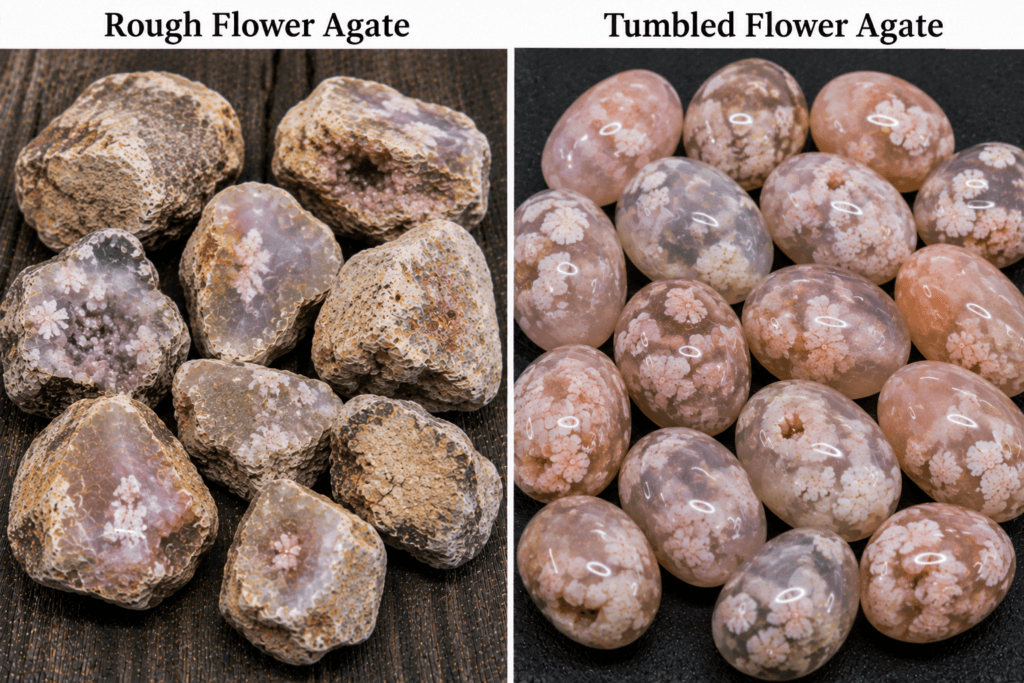
Rough Flower Agate
Polished/Tumbled Flower Agate
At a Glance
Also Known As: Cherry Blossom Agate, Sakura Agate
Mineral Family: Quartz (Chalcedony)
Chemical Formula: SiO₂
Crystal System: Trigonal (Microcrystalline)
Mohs Hardness: Approximately 6.5 to 7
Color(s): Clear, translucent, white, cream, pale pink, peach, beige, gray, and occasionally soft brown, with white, cream, pink, or peach flower-like inclusions
Primary Chakra(s): Heart Chakra
Secondary Chakra(s): Root Chakra, Sacral Chakra
Zodiac Sign(s): Taurus, Virgo
Toxic: Generally considered non-toxic for normal handling
Water Safe: Generally safe for brief contact when natural and untreated
Elixir Safe: The indirect method is recommended, particularly when inclusions, treatments, coatings, or polishing compounds are unknown.
Overview
Flower Agate is a distinctive variety of chalcedony known for soft, plume-like inclusions that resemble tiny flowers, blossoms, seeds, or botanical scenes suspended within the stone. These natural formations can range from delicate white sprays to larger pink, peach, or cream patterns that appear to bloom beneath the surface.
The stone is commonly translucent, allowing its internal formations to become the main visual feature. Some pieces contain only a few scattered blossoms, while others appear to hold entire miniature gardens.
Flower Agate entered the commercial gemstone and metaphysical markets relatively recently compared with many traditional agates. It quickly became popular because of its unusual appearance and symbolism of blooming, growth, and reaching one’s potential.
Within metaphysical traditions, Flower Agate is strongly associated with personal growth, new beginnings, self-development, manifestation, creativity, and allowing ideas or dreams to develop into something tangible.
Formation & Geological Information
Flower Agate is a variety of chalcedony, which consists primarily of microscopic silica minerals.
It formed as silica-rich fluids deposited chalcedony within cavities in volcanic rock. During this process, mineral inclusions and plume-like formations developed inside the chalcedony.
These formations create the distinctive shapes that resemble flowers or blossoms.
Despite their remarkably organic appearance, the flowers inside Flower Agate are not fossilized plants. They are naturally occurring mineral structures.
Some Flower Agate also contains small cavities lined with sparkling quartz crystals or druzy formations, adding another layer of visual interest to the stone.
Where It Is Found
Flower Agate is most strongly associated with Madagascar, which is the primary source of material sold under this name.
Deposits from Madagascar produce the translucent chalcedony and characteristic flower-like inclusions that made the stone popular in the gemstone and metaphysical markets.
Because the commercial discovery and widespread availability of Flower Agate are relatively recent, it does not have the same long historical record of use as stones such as Amethyst, Carnelian, or Lapis Lazuli.
Metaphysical & Spiritual Associations
Keywords: Growth • New Beginnings • Potential • Manifestation • Creativity • Self-Worth • Courage • Transformation • Personal Development
Flower Agate is strongly associated with the process of becoming. Its blossom-like inclusions naturally symbolize seeds developing into flowers, making the stone particularly meaningful for people beginning a new chapter or working toward something that has not yet fully taken form.
Rather than representing only the final achievement of a goal, Flower Agate symbolizes the entire process required to reach it. The seed, roots, first growth, blossoms, and eventual maturity all represent different stages of development.
Because of this symbolism, Flower Agate is often chosen when starting a business, beginning a creative project, pursuing education, developing spiritual abilities, changing careers, building confidence, or creating a new direction in life.
It is commonly associated with manifestation, but its symbolism emphasizes participation in the process. Intention may represent the seed, but consistent action is what allows that intention to grow.
Flower Agate is also connected with recognizing personal potential. Some practitioners use it when self-doubt or fear causes them to remain smaller than they feel capable of becoming. Its flower-like formations serve as a visual reminder that potential can exist long before the final result becomes visible.
Emotionally, Flower Agate is associated with self-worth and gentle encouragement. It is often described as supportive rather than forceful, making it appealing to people who want to grow without feeling pressured to transform overnight.
Its connection with creativity is also significant. Flower Agate may be chosen when an idea exists but someone is uncertain how to bring it into physical form. In this way, the stone symbolizes the transition from imagination into creation.
Spiritually, Flower Agate is often associated with discovering purpose, developing intuitive abilities, and allowing spiritual growth to unfold naturally. It may be used during meditation when exploring questions about direction, potential, identity, or the next stage of one’s journey.
Within intuitive and paranormal practices, Flower Agate may be meaningful for someone who is developing abilities such as mediumship, psychometry, energy sensitivity, or intuitive perception. Rather than symbolizing instant mastery, it represents allowing abilities to develop through experience, patience, discernment, and continued practice.
It can also serve as a reminder that spiritual development is a process. Not every impression needs to be immediately understood, and confidence often grows through repeated experience.
Chakra Associations
Flower Agate is primarily associated with the Heart Chakra, which represents love, compassion, emotional openness, self-worth, and personal growth.
Its soft pink and white colors reinforce this association in modern chakra traditions.
It may also be connected with the Root Chakra because meaningful growth requires a stable foundation. This association reflects the symbolism of a plant developing roots before it can fully bloom.
Peach and orange specimens may additionally be associated with the Sacral Chakra, which represents creativity, passion, emotional expression, and bringing ideas into form.
Together, these associations create a symbolic progression of grounding, creation, and growth.
Zodiac Associations
Flower Agate is commonly associated in modern metaphysical practice with Taurus and Virgo.
Taurus is an earth sign traditionally connected with patience, cultivation, beauty, stability, and allowing something valuable to develop over time.
Virgo is associated with growth through practice, improvement, attention to detail, and the gradual development of skills.
Because Flower Agate is a relatively recent addition to the commercial metaphysical market, its zodiac correspondences are modern associations rather than ancient or historically established traditions.
Traditional Wellness Associations
Within modern crystal healing traditions, Flower Agate is commonly associated with emotional growth, confidence, motivation, self-worth, creativity, and maintaining patience while working toward personal goals.
It may also be used in meditation or mindfulness practices by people who want to focus on personal development, emotional reflection, or creating a more hopeful outlook toward the future.
These are metaphysical associations and do not indicate that Flower Agate can treat physical or psychological conditions.
Disclaimer: Crystal healing is a spiritual practice and is not intended to diagnose, treat, cure, or prevent any medical condition. It should never replace professional medical advice, diagnosis, or treatment.
Safety
Toxicity: Flower Agate is generally considered safe for normal handling.
Water Safety: Natural, untreated Flower Agate is generally considered safe for brief contact with water. Pieces containing druzy pockets or natural fractures should not be soaked for extended periods.
Elixir Safety: The indirect method is recommended as the safest choice. Individual specimens may contain unknown mineral inclusions, treatments, coatings, dyes, or polishing compounds.
Sunlight: Natural Flower Agate is generally stable under normal light conditions. Prolonged exposure to intense sunlight should be avoided when a specimen’s treatment history is unknown.
Buying Tips
Authentic Flower Agate usually has a translucent chalcedony background containing white, cream, pink, peach, or pale brown plume-like formations.
Look for inclusions that appear naturally suspended within the stone rather than printed or painted onto its surface.
The most sought-after specimens often display clearly recognizable blossom patterns, strong depth, attractive translucency, or multiple flower-like formations.
Some pieces contain druzy quartz pockets, which are natural and can make a specimen especially distinctive.
Flower Agate can vary considerably in appearance, so not every genuine specimen will display perfectly formed “flowers.”
Did You Know?
Despite the name Flower Agate, the blossoms inside the stone were never living flowers. They are mineral formations that naturally developed inside the chalcedony, yet some are so detailed that they can resemble tiny bouquets frozen in stone.
Mystera Insight
Flower Agate reminds us that becoming who we are meant to be is not a race. A seed does not look like the flower it will eventually become, yet everything it needs to begin that journey already exists within it. Sometimes our dreams arrive before we feel ready for them. Growth begins when we stop waiting to become the person who can do it and allow ourselves to start becoming that person now.
Related Crystals
Moss Agate
Dendritic Agate
Tree Agate
Rose Quartz
Pink Opal
Garden Quartz
Green Aventurine